


Mortgage Broker vs. Bank: Why More Options Matter in 2026
Comparing a mortgage broker vs. bank can help you understand how each option works and which lending choices may be available to you. A bank generally presents mortgage products available through its own institution. A mortgage broker can review available options from multiple lending sources through one point of contact.
Integrity Mortgage is powered by IMB™ and has access to a network of more than 70+ wholesale lenders. This guide explains the difference between working with a mortgage broker and going directly to a bank, what borrowers should compare, and why having more lending relationships can matter.
Key Takeaways
- A bank generally presents mortgage products available through its own institution.
- An independent mortgage professional at a brokerage may compare available options from multiple approved wholesale lenders.
- Integrity Mortgage has access to more than 70+ wholesale lenders through IMB™.
- Borrowers can work through one primary mortgage professional who helps review options and coordinate with the selected lender.
- The lowest advertised rate does not always represent the lowest total loan cost.
- Available programs and terms depend on the borrower, property, lender requirements, and current availability.
- Access to multiple lenders does not guarantee approval, savings, pricing, or particular loan terms.
Understanding Mortgage Brokers and Banks

A bank is a financial institution that may provide mortgages alongside checking accounts, savings accounts, credit cards, and other services. When you apply through a bank, its loan officer generally presents mortgage products available from that institution.
A mortgage broker acts as an intermediary between the borrower and approved wholesale lenders. The broker can help identify potential options, collect application information and documentation, and coordinate communication with the selected lender.
The lender provides the funds, completes underwriting, and makes the final approval decision.
The primary difference is choice: a bank generally begins with its own mortgage products, while a broker may evaluate options from multiple lending relationships.
Why Consider a Mortgage Broker Before Going Directly to a Bank?
Applying through one bank can limit your initial comparison to that institution’s available products. If its programs or guidelines do not align with your circumstances, you may need to contact another institution and begin a separate conversation.
A mortgage broker can start with a broader network of approved lending relationships. Instead of independently contacting several banks, you work with one mortgage professional who can help review potential options across the brokerage’s network.
This may be helpful when:
- You want to compare more than one lending source.
- You are self-employed or have multiple income sources.
- Your financial circumstances require closer review.
- You are purchasing a property with unique characteristics.
- You want help understanding differences between proposed options.
- One lender’s requirements do not appear to fit your circumstances.
Access to a Broad Network of Wholesale Lenders
Integrity Mortgage is powered by IMB™ and has access to a network of 70+ wholesale lenders.
This means borrowers are not automatically limited to the products offered by one bank. An Integrity Mortgage professional can review available options within that network and identify lenders or programs that may align with the borrower’s circumstances.
Lenders may differ in how they evaluate:
- Income and employment
- Self-employment documentation
- Credit history
- Current financial obligations
- Available assets and reserves
- Property types and occupancy
- Program eligibility
- Underwriting requirements
A borrower who does not fit one lender’s guidelines may have a potential option with another lender, although approval is never guaranteed.
Access to more than 70+ wholesale lenders does not mean every lender or program will be available to every borrower. It provides a broader starting point for exploring potential options than beginning with one institution alone.
Learn more about Integrity Mortgage’s loan options.
How to Compare a Mortgage Broker and Bank
A mortgage broker will not always have a lower rate than a bank, and a bank will not always have a lower rate than a broker.
Mortgage pricing and terms can depend on:
- Credit history
- Income and employment
- Property type and occupancy
- Loan amount and structure
- Available assets
- Mortgage insurance
- Discount points
- Lender credits
- Rate-lock timing
- Market conditions
An advertised rate may be based on assumptions that do not match your circumstances. It may also require discount points or include other conditions.
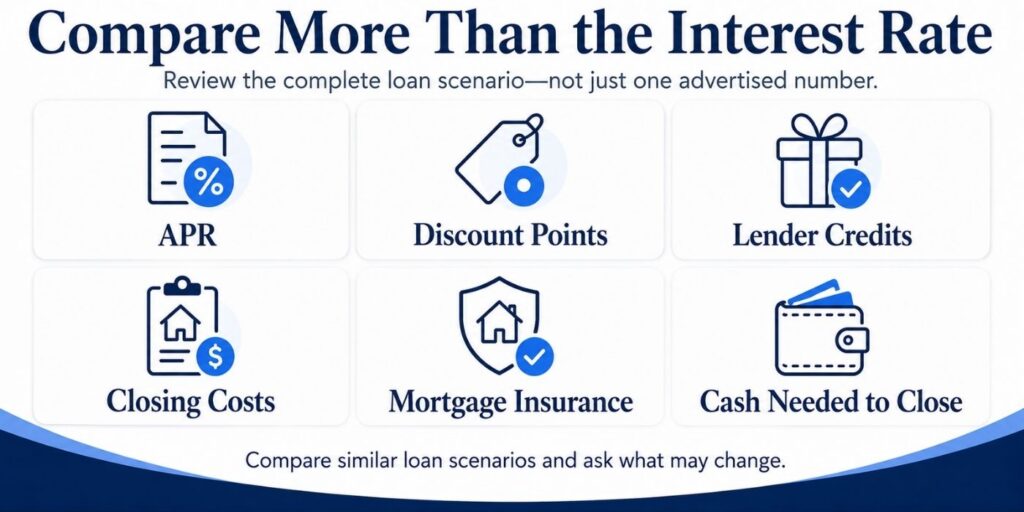
When comparing proposed options, review:
- Loan type and term
- Interest rate
- Annual percentage rate, or APR
- Rate-lock status
- Estimated principal and interest
- Mortgage insurance, if applicable
- Origination charges
- Discount points or lender credits
- Estimated closing costs
- Estimated cash needed to close
The goal is not simply to find the lowest advertised number. It is to understand which available option provides an appropriate combination of costs, terms, service, and loan structure for your transaction.
Use the Loan Estimate to Review Your Options
The Loan Estimate is a standardized disclosure containing important information about a proposed mortgage. Because lenders use the same general form, borrowers can use Loan Estimates to compare expected terms and costs more consistently.
When reviewing Loan Estimates:
- Make sure the loan scenarios are comparable.
- Check whether each interest rate is locked.
- Review the APR as well as the interest rate.
- Look for discount points or lender credits.
- Compare lender charges and estimated closing costs.
- Review the estimated cash needed to close.
- Ask why any figures differ from what was discussed.
A Loan Estimate is not a final loan approval or commitment to lend. Proposed information may change when permitted by applicable requirements or when details of the transaction change.
Questions to Ask Before Choosing a Mortgage Provider

Before deciding whether to work with a mortgage broker or bank, consider asking:
- Are you acting as a mortgage broker, lender, or both?
- Which company will provide the loan funds?
- How many lending sources can you consider?
- Which options appear relevant to my circumstances?
- Why are you recommending this particular option?
- Are there alternatives I should compare?
- Is the interest rate currently locked?
- Are discount points or lender credits included?
- Which fees are associated with the proposed loan?
- Who will communicate with me throughout the process?
- What are the company and individual NMLS identification numbers?
A mortgage professional should explain what is estimated, what may change, and which company makes the final lending decision.
Avoid Common Mistakes When Choosing a Mortgage Provider
Choosing Based Only on an Advertised Rate
An advertised rate may not reflect your qualifications or the complete cost of the mortgage. Compare the APR, points, credits, costs, and rate-lock status.
Assuming Your Current Bank Is Automatically the Best Choice
Convenience can be helpful, but having an existing account does not guarantee that the bank’s mortgage product will be the most appropriate for your transaction.
Comparing Different Loan Scenarios
One proposal may appear less expensive because it uses a different loan structure or assumptions. Compare similar scenarios whenever possible.
Assuming a Broker Works With Every Lender
A mortgage broker works with an approved network of lenders, not every lender in the market.
Treating an Estimate as an Approval
A discussion, prequalification, preapproval, or Loan Estimate is not a final loan approval. All financing remains subject to review, documentation, underwriting, and approval.
Why Start With Integrity Mortgage Instead of One Bank?
When you begin with one bank, your initial choices are generally limited to the mortgage products that institution offers.
Integrity Mortgage’s independent mortgage professionals can review available options through a network of more than 70+ wholesale lenders powered by IMB™. This provides a broader starting point than beginning with one bank’s product menu.
Working with Integrity Mortgage provides:
- Access to multiple approved wholesale lending relationships
- A broader starting point for exploring potential mortgage options
- One independent mortgage professional helping coordinate the comparison
- Help understanding differences between lender guidelines
- Guidance throughout the selected lender’s process
- A primary point of contact for questions and updates
Every borrower and property is different. An Integrity Mortgage professional can discuss your circumstances, explain relevant choices and tradeoffs, and help you understand the next steps.
Access to multiple lenders does not guarantee approval, savings, pricing, or particular loan terms. All potential options remain subject to borrower qualifications, property details, lender requirements, program availability, and underwriting.

For personalized guidance, learn more about Integrity Mortgage or read reviews from previous clients.
FAQ: Mortgage Broker vs. Bank
No. A bank is a financial institution that may provide the loan funds. A mortgage broker acts as an intermediary between the borrower and an approved lender. The lender provides the financing and makes the final underwriting decision.
A bank generally presents products available through its institution. A mortgage broker may review available options from multiple approved wholesale lenders, providing a broader comparison through one mortgage professional.
Integrity Mortgage is powered by IMB™ and has access to a network of more than 70+ wholesale lenders. Not every lender or program will be appropriate or available for every borrower. Availability depends on borrower qualifications, property details, lender requirements, and current program participation.
No. Costs and terms vary according to the borrower, property, lender, loan structure, and market conditions. Working with a broker provides the opportunity to review options from multiple lending relationships but does not guarantee lower costs.
Review the APR, rate-lock status, origination charges, discount points, lender credits, mortgage insurance, estimated closing costs, estimated payment, cash needed to close, and applicable loan features.