
Mortgage Broker vs. Bank: Why More Options Matter in 2026

Comparing a mortgage broker vs. bank can help you understand how each option works and which lending choices may be available to you. A bank generally presents mortgage products available through its own institution. A mortgage broker can review available options from multiple lending sources through one point of contact.

Integrity Mortgage is powered by IMB™ and has access to a network of more than 70+ wholesale lenders. This guide explains the difference between working with a mortgage broker and going directly to a bank, what borrowers should compare, and why having more lending relationships can matter.

Key Takeaways

  • A bank generally presents mortgage products available through its own institution.
  • An independent mortgage professional at a brokerage may compare available options from multiple approved wholesale lenders.
  • Integrity Mortgage has access to more than 70+ wholesale lenders through IMB™.
  • Borrowers can work through one primary mortgage professional who helps review options and coordinate with the selected lender.
  • The lowest advertised rate does not always represent the lowest total loan cost.
  • Available programs and terms depend on the borrower, property, lender requirements, and current availability.
  • Access to multiple lenders does not guarantee approval, savings, pricing, or particular loan terms.

Understanding Mortgage Brokers and Banks

A bank is a financial institution that may provide mortgages alongside checking accounts, savings accounts, credit cards, and other services. When you apply through a bank, its loan officer generally presents mortgage products available from that institution.

A mortgage broker acts as an intermediary between the borrower and approved wholesale lenders. The broker can help identify potential options, collect application information and documentation, and coordinate communication with the selected lender.

The lender provides the funds, completes underwriting, and makes the final approval decision.

The primary difference is choice: a bank generally begins with its own mortgage products, while a broker may evaluate options from multiple lending relationships.

Why Consider a Mortgage Broker Before Going Directly to a Bank?

Applying through one bank can limit your initial comparison to that institution’s available products. If its programs or guidelines do not align with your circumstances, you may need to contact another institution and begin a separate conversation.

A mortgage broker can start with a broader network of approved lending relationships. Instead of independently contacting several banks, you work with one mortgage professional who can help review potential options across the brokerage’s network.

This may be helpful when:

  • You want to compare more than one lending source.
  • You are self-employed or have multiple income sources.
  • Your financial circumstances require closer review.
  • You are purchasing a property with unique characteristics.
  • You want help understanding differences between proposed options.
  • One lender’s requirements do not appear to fit your circumstances.

Access to a Broad Network of Wholesale Lenders

Integrity Mortgage is powered by IMB™ and has access to a network of 70+ wholesale lenders.

This means borrowers are not automatically limited to the products offered by one bank. An Integrity Mortgage professional can review available options within that network and identify lenders or programs that may align with the borrower’s circumstances.

Lenders may differ in how they evaluate:

  • Income and employment
  • Self-employment documentation
  • Credit history
  • Current financial obligations
  • Available assets and reserves
  • Property types and occupancy
  • Program eligibility
  • Underwriting requirements

A borrower who does not fit one lender’s guidelines may have a potential option with another lender, although approval is never guaranteed.

Access to more than 70+ wholesale lenders does not mean every lender or program will be available to every borrower. It provides a broader starting point for exploring potential options than beginning with one institution alone.

Learn more about Integrity Mortgage’s loan options.

How to Compare a Mortgage Broker and Bank

A mortgage broker will not always have a lower rate than a bank, and a bank will not always have a lower rate than a broker.

Mortgage pricing and terms can depend on:

  • Credit history
  • Income and employment
  • Property type and occupancy
  • Loan amount and structure
  • Available assets
  • Mortgage insurance
  • Discount points
  • Lender credits
  • Rate-lock timing
  • Market conditions

An advertised rate may be based on assumptions that do not match your circumstances. It may also require discount points or include other conditions.
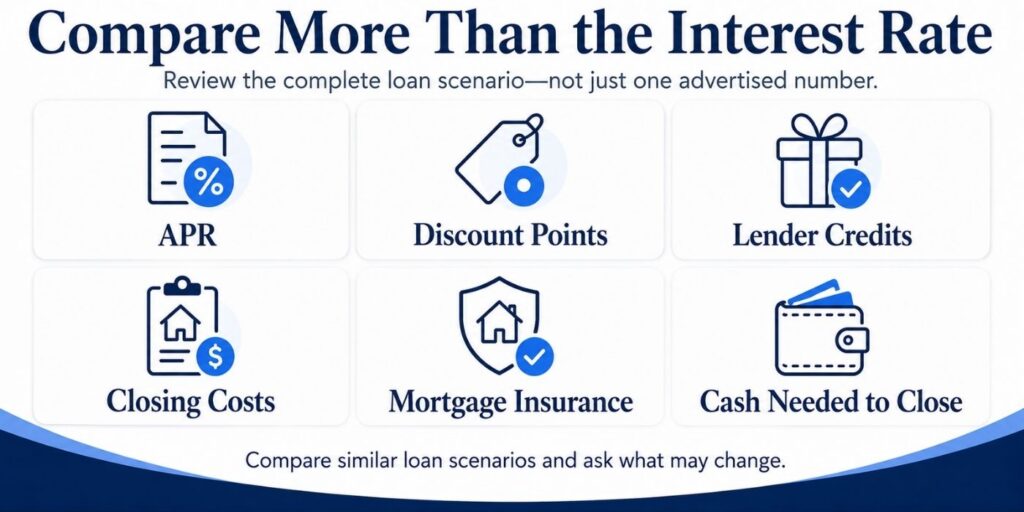
When comparing proposed options, review:

  • Loan type and term
  • Interest rate
  • Annual percentage rate, or APR
  • Rate-lock status
  • Estimated principal and interest
  • Mortgage insurance, if applicable
  • Origination charges
  • Discount points or lender credits
  • Estimated closing costs
  • Estimated cash needed to close

The goal is not simply to find the lowest advertised number. It is to understand which available option provides an appropriate combination of costs, terms, service, and loan structure for your transaction.

Use the Loan Estimate to Review Your Options

The Loan Estimate is a standardized disclosure containing important information about a proposed mortgage. Because lenders use the same general form, borrowers can use Loan Estimates to compare expected terms and costs more consistently.

When reviewing Loan Estimates:

  • Make sure the loan scenarios are comparable.
  • Check whether each interest rate is locked.
  • Review the APR as well as the interest rate.
  • Look for discount points or lender credits.
  • Compare lender charges and estimated closing costs.
  • Review the estimated cash needed to close.
  • Ask why any figures differ from what was discussed.

A Loan Estimate is not a final loan approval or commitment to lend. Proposed information may change when permitted by applicable requirements or when details of the transaction change.

Questions to Ask Before Choosing a Mortgage Provider

Before deciding whether to work with a mortgage broker or bank, consider asking:

  1. Are you acting as a mortgage broker, lender, or both?
  2. Which company will provide the loan funds?
  3. How many lending sources can you consider?
  4. Which options appear relevant to my circumstances?
  5. Why are you recommending this particular option?
  6. Are there alternatives I should compare?
  7. Is the interest rate currently locked?
  8. Are discount points or lender credits included?
  9. Which fees are associated with the proposed loan?
  10. Who will communicate with me throughout the process?
  11. What are the company and individual NMLS identification numbers?

A mortgage professional should explain what is estimated, what may change, and which company makes the final lending decision.

Avoid Common Mistakes When Choosing a Mortgage Provider

Choosing Based Only on an Advertised Rate

An advertised rate may not reflect your qualifications or the complete cost of the mortgage. Compare the APR, points, credits, costs, and rate-lock status.

Assuming Your Current Bank Is Automatically the Best Choice

Convenience can be helpful, but having an existing account does not guarantee that the bank’s mortgage product will be the most appropriate for your transaction.

Comparing Different Loan Scenarios

One proposal may appear less expensive because it uses a different loan structure or assumptions. Compare similar scenarios whenever possible.

Assuming a Broker Works With Every Lender

A mortgage broker works with an approved network of lenders, not every lender in the market.

Treating an Estimate as an Approval

A discussion, prequalification, preapproval, or Loan Estimate is not a final loan approval. All financing remains subject to review, documentation, underwriting, and approval.

Why Start With Integrity Mortgage Instead of One Bank?

When you begin with one bank, your initial choices are generally limited to the mortgage products that institution offers.

Integrity Mortgage’s independent mortgage professionals can review available options through a network of more than 70+ wholesale lenders powered by IMB™. This provides a broader starting point than beginning with one bank’s product menu.

Working with Integrity Mortgage provides:

  • Access to multiple approved wholesale lending relationships
  • A broader starting point for exploring potential mortgage options
  • One independent mortgage professional helping coordinate the comparison
  • Help understanding differences between lender guidelines
  • Guidance throughout the selected lender’s process
  • A primary point of contact for questions and updates

Every borrower and property is different. An Integrity Mortgage professional can discuss your circumstances, explain relevant choices and tradeoffs, and help you understand the next steps.

Access to multiple lenders does not guarantee approval, savings, pricing, or particular loan terms. All potential options remain subject to borrower qualifications, property details, lender requirements, program availability, and underwriting.

For personalized guidance, learn more about Integrity Mortgage or read reviews from previous clients.

FAQ: Mortgage Broker vs. Bank

Is a mortgage broker the same as a bank?

No. A bank is a financial institution that may provide the loan funds. A mortgage broker acts as an intermediary between the borrower and an approved lender. The lender provides the financing and makes the final underwriting decision.

Why might I choose a mortgage broker instead of a bank?

A bank generally presents products available through its institution. A mortgage broker may review available options from multiple approved wholesale lenders, providing a broader comparison through one mortgage professional.

Does Integrity Mortgage have access to more than 70+ lenders?

Integrity Mortgage is powered by IMB™ and has access to a network of more than 70+ wholesale lenders. Not every lender or program will be appropriate or available for every borrower. Availability depends on borrower qualifications, property details, lender requirements, and current program participation.

Is a mortgage broker always less expensive than a bank?

No. Costs and terms vary according to the borrower, property, lender, loan structure, and market conditions. Working with a broker provides the opportunity to review options from multiple lending relationships but does not guarantee lower costs.

What should I compare besides the interest rate?

Review the APR, rate-lock status, origination charges, discount points, lender credits, mortgage insurance, estimated closing costs, estimated payment, cash needed to close, and applicable loan features.

The Complete Home Buyer’s Guide for 2026 with a model house, home buying checklist, and keys.

Tips on Mortgage: A Practical Guide for Home Buyers in 2026

Buying a house is one of the largest purchases most people ever make. With mortgage rates hovering between 6.4% and 6.6% in mid-2026, even small differences in how you prepare can save or cost you tens of thousands of dollars. This step by step guide walks you through the entire home buying process, from checking your credit to signing at the closing table.

Key Takeaways

  • Check your credit report and debt to income ratio early so you can fix problems before you apply for a mortgage.
  • Know how much house you can truly afford, not just what a lender says you qualify for.
  • Understand how your down payment size affects your mortgage loan options, monthly payments, and interest rate.
  • Use a local mortgage broker with strong Google reviews to shop and compare loans and pricing from several lenders in one place.
  • Get pre-approved before you start looking at homes so you can make competitive offers quickly.
  • Read every line of the loan terms, fees, and closing costs, because the headline interest rate is only part of the story.

Understanding Mortgage Basics in 2026

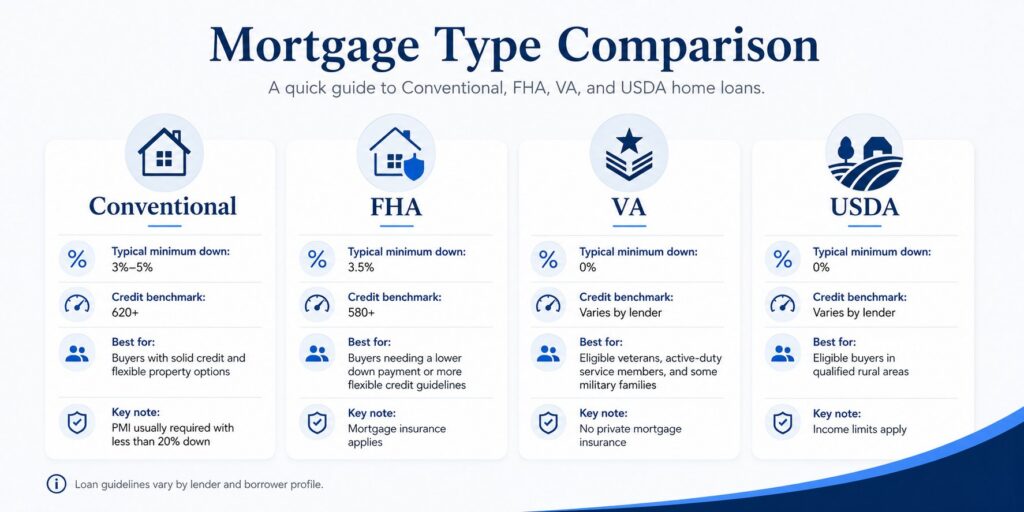
Comparison of Conventional, FHA, VA, and USDA mortgage types, including minimum down payments, credit benchmarks, best uses, and key notes.

A mortgage is a loan to buy a home, secured by the property itself as collateral. If the borrower defaults, the lender can foreclose. With 2026 interest rate volatility driven by shifting Fed policy and bond yields, understanding these basics matters more than ever.

A home loan for a primary residence typically gets the best rates and lowest down payment requirements. Second homes and investment property loans come with higher rates, stricter underwriting, and larger required reserves.

Here are the main mortgage types:

  • Conventional loan – offered through a bank, credit union, or private lender; typically 3–5% minimum down payment; a credit score of at least 620 is generally needed.
  • FHA loan – insured by a government agency (FHA); FHA loans require a minimum down payment of 3.5% for scores of 580+.
  • VA loan – for eligible veterans; often zero down payment and no private mortgage insurance.
  • USDA – zero down in eligible rural areas with income limits.

A 30-year fixed mortgage locks your interest rate for the full term, giving stable monthly payments. A 5/6 ARM might start lower but resets after five years, creating payment uncertainty. Each monthly mortgage payment includes principal, interest, property taxes, homeowners insurance, and possibly mortgage insurance. Mortgage insurance is needed if the down payment is less than 20%. Factor all of these in when estimating affordability.

Check Your Credit Report and Strengthen Your Credit Score

When you apply for a mortgage, the lender will pull your full credit report from Experian, Equifax, and TransUnion. You should check your credit first. In 2026, consumers can still get free reports at AnnualCreditReport.com, and reviewing all three bureaus helps spot inaccuracies before they cost you money.

Common errors include wrong balances, closed accounts showing as open, and late payments that aren’t yours. Even one mistake can raise the interest rate you’re offered or increase your required down payment.

To dispute errors, gather supporting documentation (bank statements, receipts), submit a dispute to each bureau reporting the issue, and contact the creditor that furnished the data. Investigations typically take around 30 days.

Credit score tiers matter significantly. Lenders typically prefer a credit score of at least 620 for a conventional loan, but borrowers in the mid-700s can qualify for rates 0.5–1.5% lower than those in the mid-600s. Improving your credit score can lead to better mortgage rates and save thousands over the life of a loan.

Practical steps to raise your score in 3–12 months:

  • Pay down credit card balances to keep utilization under 30%, ideally under 10%.
  • Make every payment on time, including small bills.
  • Avoid opening new high-limit accounts or co-signing for others.
  • Avoid credit problems like large unexplained financial changes before applying.
Home buyer reviewing a credit report and financial figures on a laptop before applying for a mortgage.

Know How Much House You Can Afford

The maximum a lender approves is almost always more than what’s actually comfortable. Smart home buyers set their own ceiling based on real household spending, not just a lender’s formula.

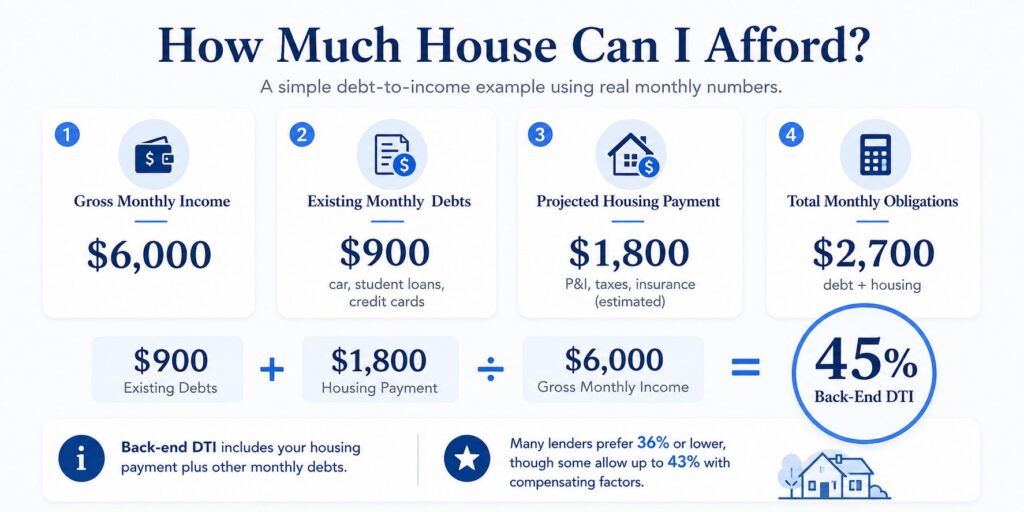
The debt to income ratio is the key metric. Front-end DTI covers housing costs only; back-end DTI includes all monthly debt obligations. Many lenders prefer a DTI of 36% or lower, though some allow up to 43% with compensating factors.

Here’s a simple example: suppose your gross monthly income is $6,000 and your current monthly debt payments total $900 (car, student loan, credit cards). That’s a 15% DTI without a mortgage. Add a projected mortgage payment of $1,800, and your back-end DTI jumps to 45%, which may push beyond what most lenders find comfortable.

Debt-to-income example showing $6,000 monthly income, $900 in debts, a $1,800 housing payment, and a 45% back-end DTI.

Use an online affordability calculator, then review our Denver buyer payment strategy guide as you build a full household budget that accounts for utilities, childcare, transportation, groceries, and savings. Rising property taxes and home insurance costs across many markets in 2025–2026 can push your payment higher over time, so leave a 5–10% buffer.

Don’t drain your emergency savings for a bigger house. Keeping at least 3–6 months of expenses in cash reserves protects your financial situation against income shocks, surprise repairs, and the costs of home ownership that appear in year one.

Plan Your Down Payment and Upfront Costs

Your down payment size directly affects your loan amount, monthly payments, and whether you pay private mortgage insurance. A common down payment guideline is 20% of the home’s price. A 20% down payment can help avoid PMI, while the median first-time homebuyer down payment is closer to 10%.

Consider a $400,000 home purchase. At 20% down ($80,000), you borrow $320,000 with no PMI. At 5% down ($20,000), you borrow $380,000 and pay PMI until you reach 20% equity. At a 6.5% interest rate, the difference in total interest paid over 30 years is substantial. A larger down payment reduces lender risk and can improve loan terms across the board.

Common down payment sources include personal savings, liquidated investments, 401(k) loans or withdrawals (watch for taxes and penalties), and gifts from family documented with a gift letter. Many states also offer down payment assistance programs, some providing forgivable loans of $10,000–$15,000 for eligible buyers.

Don’t spend every dollar on the down payment. Moving costs, minor repairs, and furnishings in the first year require more money than most people expect.

Closing costs typically run 2–5% of the loan amount. On a $400,000 home, that’s $8,000 to $20,000 covering lender fees, appraisal ($300–$800), title search, recording fees, and prepaid taxes and insurance. Seller credits or lender credits can offset these costs, though a lender credit usually means accepting a slightly higher interest rate. Decide whether the trade-off fits your financial means and timeline.

Compare Loans, Lenders, and Mortgage Brokers

Shopping for a mortgage in 2026 can easily save thousands over the life of a home loan. Comparing multiple lenders can save borrowers thousands, and research shows that getting one additional rate quote can save $1,500 on average.

You can go directly to a bank or credit union, or work with a mortgage broker who shops multiple lenders’ pricing, guidelines, and loan terms on your behalf. A loan officer at a single institution offers only that institution’s products, while a broker accesses wholesale lenders you might not find on your own.

A local mortgage broker brings real advantages: better knowledge of neighborhood appraisals, state-specific assistance programs, and local underwriting quirks. Use Google reviews and recent online ratings to evaluate brokers and lenders. Focus on comments about communication, closing on time, and resolving issues, not just star counts.

Get at least three written loan estimate documents on the same day when possible. Comparing loans on the same day ensures accurate estimates so you can fairly compare the interest rate, APR, lender fees, and mortgage insurance. Shop for a loan within a 45-day period to minimize credit impact, since scoring models treat multiple mortgage inquiries in that window as a single hard inquiry.

Always ask a broker directly about compensation: how they’re paid, whether there are lender credits or points, and whether any prepayment penalties are hidden in the fine print. Compare all loan terms, not just the mortgage rate, to find the best deal.

Get Pre-Approved Before You House Hunt

Pre-qualification is informal, based on self-reported income and debts. Pre-approval is documented: the lender pulls your credit, verifies income and assets, and issues a conditional commitment. The mortgage application process generally involves structured steps, and key milestones include pre-approval, loan processing, and closing.

Documents you’ll need to apply for a mortgage and obtain pre-approval:

  • Last 30 days of pay stubs
  • Last 2 years of W-2s or tax returns (self employed borrowers should include business returns and profit/loss statements)
  • 2–3 months of bank statements and financial accounts
  • Government-issued ID
  • Statements for all debts (student loans, car loans, credit cards)

Lenders typically look for at least two years of stable employment. A strong pre-approval letter, dated recently with a clear maximum loan amount, helps you compete in tight markets. Preapproval helps show sellers that you are a serious buyer who can perform.

Shopping for a mortgage within 45 days minimizes credit score impact because multiple inquiries are treated as one for scoring purposes. Some local brokers and lenders even offer fully underwritten pre-approvals, which make your offer nearly as strong as cash because income and assets are already verified.

Start 60–90 days before you plan to make offers. That gives you time to fix credit issues, gather documents, and get into the best programs without rate lock pressure. If you are deciding where to apply, learn more about the differences between a mortgage broker and a bank.

Understand Loan Terms, Interest Rates, and Fine Print

The interest rate on your mortgage agreement is only one piece of the puzzle. You must read all loan terms before you sign. The Annual Percentage Rate (APR) includes many fees and gives a better picture of the loan’s total cost than the rate alone.

Loan term length also matters. A 15-year fixed on a $300,000 loan at 6.0% has higher monthly payments than a 30-year at 6.5%, but you’ll pay dramatically less total interest and own your home sooner. Buying discount points can reduce the interest rate in exchange for higher upfront fees, which may make sense if you plan to stay long-term.

Rates can change daily and should be locked in before closing. A rate lock guarantees your quoted rate for a set period (30, 45, or 60 days). In volatile 2026 conditions, locking protects you if rates rise before your closing date.

For adjustable-rate mortgages, understand the initial fixed period, the index, margin, caps, and how your payment could jump after the reset. Avoid features like prepayment penalties, balloon payments, or negative amortization unless you fully understand the risk and have a clear exit plan.

Federal law requires lenders to provide a standardized loan estimate within three business days of your loan application, and a closing disclosure at least three days before closing. Lenders must provide a loan estimate after application submission. Compare both documents carefully for last-minute changes.

Avoid Common Mortgage Mistakes Before Closing

From the moment you apply for a mortgage until closing day, your finances are under a microscope. The lender needs to verify financial information during the loan processing stage, and any major change can derail your approval.

Common pitfalls to avoid:

  • Avoid opening new credit accounts during the mortgage application process.
  • Don’t finance a car, take on new debt, or add a co borrower without discussing it with your lender.
  • Large unexplained deposits into your financial accounts will trigger questions.
  • Changing jobs mid-process can reset employment verification.

Keep all financial paperwork organized and respond quickly to underwriter requests. Responding quickly to requests for documents can help keep the mortgage process on schedule and prevent your rate lock from expiring.

A home appraisal is required by the lender to confirm the property is worth the loan amount. A home inspection is separate and evaluates the condition of the roof, plumbing, electrical, and structure. Even when not required, an inspection protects the buyer and can be a powerful negotiating tool.

At closing, expect to review the closing disclosure at least three business days in advance. Bring a certified or cashier’s check or wire funds carefully, verifying wire instructions to avoid fraud. If the numbers on the final documents don’t match expectations, pause and get clear answers before you sign. Even under time pressure, careful consideration of every line protects your money and your home purchase.

Family standing in front of their new home with moving boxes on the porch after completing the mortgage process.

For personalized guidance on comparing lenders and choosing a loan, learn more about Integrity Mortgage and our local mortgage team.

FAQ: Practical Questions About Getting a Mortgage

How long does it take to get a mortgage from application to closing in 2026?

Most straightforward mortgage applications close in 30 to 45 days. Complex cases involving appraisal delays, title issues, or income verification for self employed borrowers can stretch to 60 days or longer. Staying organized and responsive with documentation helps you stay on the shorter end.

Is it better to pay off debt or save for a down payment first?

It depends on your financial situation. High-interest debt like credit cards often costs more over time, and paying it down improves your debt to income ratio, which can help you qualify for a lower rate. But draining savings completely to eliminate debt leaves you without reserves. Balance both: reduce high-cost debt while maintaining enough savings to cover your down payment and several months of expenses.

Should I work with a local mortgage broker or an online lender?

A local mortgage broker offers personal service, knowledge of area appraisals and state assistance programs, and relationships with underwriters that can speed up processing. Online lenders may offer streamlined apps and competitive digital pricing. Check Google reviews for either option, focusing on recent feedback about communication, timeliness, and closing outcomes. Many home buyers find that a local broker who can shop pricing from several lenders delivers the best overall experience.

What if my credit score is borderline, around the mid-600s?

If your score temporarily lowers your buying power, delaying 6–12 months to improve it can reduce your rate by 0.5–1.0% or more, potentially saving thousands over the loan’s life. Pay down revolving balances, correct reporting errors, and avoid new debt. However, if mortgage rates are expected to rise, waiting could cost more in interest than you save from a higher score. Weigh your own credit improvement trajectory against rate forecasts before you decide.

Do I really need to compare more than one or two lenders?

Yes. Research consistently shows that getting one additional rate quote saves $1,500 on average. Request a loan estimate from at least three sources, including a local mortgage broker, a credit union, and a direct lender. Comparing on the same day keeps rate conditions consistent, giving you the clearest picture of which lender offers lower monthly payments and the most favorable overall terms.

Tips for Refinancing a Mortgage to Improve Cash Flow in 2026

Refinancing can be a smart move in 2026, especially if your current mortgage was opened when mortgage rates were higher. But the best tips for refinancing mortgage debt all come down to the same question: will the new loan improve your financial future after fees, time, and risk are included?

Key Takeaways

Mortgage refinance decisions in 2026 are mainly about lowering your mortgage rate, adjusting your loan term, or tapping home equity while managing refinancing cost. A refinance loan can create lower monthly payments, but it can also raise the total cost if you roll fees into the balance or restart a long term. The goal is not just to save money this month, but to improve the life of the loan.

  • Refinancing only makes sense if long-term savings on interest payments exceed upfront fees and you stay past the break-even point.
  • Lenders in 2026 typically want a solid credit score, often 680+ for competitive offers and 740+ for the best interest rates, plus a healthy debt to income ratio, often under 43%.
  • Compare at least three mortgage lenders, including banks and credit unions, because lenders charge different origination fees, points, and title insurance costs.
  • Evaluate whether switching from an adjustable rate mortgage to a fixed rate mortgage gives you more predictable monthly payments.
  • A cash out refinance can be useful, but it increases debt secured by your home and should be reviewed carefully with a financial advisor or financial adviser.

What Is Mortgage Refinancing and When Does It Make Sense?

Mortgage refinancing replaces your current mortgage with a new home loan, usually to change the mortgage rate, loan term, or loan type. The new lender pays off the current mortgage in full, and you begin making mortgage payments under updated terms on a new mortgage.

Refinancing involves a new approval process, new underwriting, and usually new closing costs. It can be worth it when lower interest rates reduce your monthly payments enough to offset fees.

Common 2026 reasons to refinance include:

  • Locking in lower rates after market drops, especially if rates drop well below your current loan rate.
  • Consolidating high-interest credit cards or other debts.
  • Removing private mortgage insurance if you now have enough equity in your home.
  • Accessing home equity through cash-out refinancing.
  • Moving from an adjustable rate mortgage to a fixed rate mortgage for payment stability.

Most experts recommend refinancing your mortgage if you can lower your current interest rate by at least 0.75 to 1 percent to make it worthwhile, though some borrowers benefit from a 0.5% cut if the loan amount is large and fees are low. Lowering the interest rate on your mortgage can significantly reduce your monthly payments, as lower rates typically mean lower payments.

Be careful, though. Refinancing can extend your payoff date, reset amortization, and increase total mortgage interest if you stretch an original mortgage back to a fresh 30-year term.

Check Your Credit Score and Debt-to-Income Ratio First

Before you submit a loan application, check your credit score and debt to income ratio. Lenders offer the best interest rates to borrowers with the highest credit scores, and most lenders price refinance loans heavily around credit tiers.

Here are the key benchmarks:

  • Aim for 740+ for the best mortgage rate, 700+ for strong offers, and 660–679 as acceptable but costlier. Borrowers with poor credit may still qualify through certain programs, but they usually face higher costs.
  • Conventional refinance programs often prefer DTI at or below 43%; under 36% can help you qualify for better pricing.
  • FHA options through the federal housing administration may allow more flexibility, but lenders still review risk closely.

Your DTI ratio is your total monthly debt payments, including estimated new mortgage payment, divided by gross monthly income.

For example:

Monthly debtsGross monthly incomeDTI
$2,200$6,500About 34%

That 34% DTI is within the target range for many refinance lenders.

To improve your profile 3–6 months before refinancing your mortgage:

  • Pay every bill on time.
  • Reduce credit card balances below 30% utilization.
  • Avoid opening new credit cards, taking out auto loans, or making large purchases before your refinance, as this can negatively impact your credit profile.
  • Review your credit report for errors.

Refinancing can negatively impact your credit score due to hard inquiries, but it may improve your score over time if you manage your payments responsibly after refinancing. If your credit score improved since the original loan, ask lenders to reprice your offer before locking.

Know How Much Equity You Have in Your Home

Home equity equals home value minus mortgage balance. Knowing how much equity you have matters because your loan-to-value ratio, or LTV, determines your eligibility and affects your costs.

For example, if your home is worth $400,000 and your current mortgage balance is $280,000, you have $120,000 in home equity, or 30% equity. Your LTV is 70%.

Most lenders require that you have at least 20% home equity before refinancing, which is calculated by subtracting your current loan balance from your home’s current value. Lenders typically want at least 20% equity, or 80% LTV, for the most favorable rate and to avoid private mortgage insurance on a new loan. You may also see private mortgage insurance pmi referenced in older documents or lender explanations.

To estimate value:

  • Review recent comparable home sales.
  • Check online valuation tools.
  • Watch local housing prices.
  • Confirm with a professional appraisal if you move forward.

For a cash-out refinance, lenders typically require that homeowners have at least 20% equity in their home. Conventional cash-out refinance limits often cap LTV around 75%–80%, so homeowners with less equity may need to wait or compare loan options such as a home equity loan.

Clarify Your Refinancing Goal: Payment, Rate, Term, or Cash-Out

Pick one primary goal before shopping: lower monthly payments, a lower interest rate, a shorter loan term, or cash out. Your goal affects which mortgage loan structure makes sense.

  • If you want a lower monthly payment, resetting to a 30-year term can help. However, refinancing can lead to lower monthly payments, but it may also result in a higher overall loan amount if closing costs are rolled into the new mortgage.
  • If you want to pay off the loan sooner, refinancing from a 30-year loan to a 15-year fixed rate loan can save tens of thousands in interest payments, but loan payments will usually rise.
  • If you have an adjustable rate mortgage, refinancing to a fixed-rate mortgage can provide stability in your monthly payments, especially if you anticipate rising interest rates.
  • A fixed interest rate also makes budgeting easier because property taxes and insurance may change, but principal and interest stay predictable on a fixed rate mortgage.
  • A cash-out refinance allows homeowners to convert home equity into cash by taking out a new mortgage for more than the previous mortgage balance, with the difference paid out in cash.

Cash-out refinancing can be used for various purposes, such as making home improvements, paying for education, or consolidating debt, but it is advised to consult a financial adviser before proceeding. Common uses include renovations, paying off high-rate credit cards, and college tuition. The risk is that unsecured debt becomes debt secured by your home.

Compare Mortgage Lenders and Loan Options Carefully

In 2026, get at least three written Loan Estimates from different mortgage lenders within a two-week window to minimize credit impact. It is advisable to gather quotes from at least three different lenders to compare Loan Estimates accurately.

Compare:

  • Interest rate
  • APR
  • Points
  • closing costs
  • appraisal fee
  • origination fees
  • Monthly payment for the same loan type and term
  • Whether the offer is from your current lender, the same lender that holds your first mortgage, a bank, or credit unions

Compare the Annual Percentage Rate (APR) instead of just the interest rate, as the APR provides the true cost of the loan by factoring in lenders’ fees. The modern loan estimate replaced the older good faith estimate, but some borrowers still use that phrase casually. You can review official Loan Estimate guidance from the Consumer Financial Protection Bureau.

A fixed rate mortgage keeps the same rate for the loan term. An adjustable rate mortgage may start lower but can reset later. Some borrowers choose an ARM if they plan to sell soon; others choose a fixed rate loan for stability.

Ask every lender about:

  • 30-, 45-, and 60-day rate locks
  • Extension fees
  • Float-down options if market mortgage rates drop before closing
  • Whether your current title insurance policy can reduce title fees
  • Whether a new title search is required

Negotiating loan fees and interest rates is essential, and one can use competing offers as leverage. Show your preferred lender a better offer and ask for lower lender fees or a small rate reduction.

Understand the True Cost of Refinancing and Your Break-Even Point

One potential downside of refinancing is that it typically involves closing costs, which can range from 3% to 6% of the loan amount, making it essential to calculate whether the savings outweigh these costs. Refinance closing costs typically average 2% to 6% of the new loan amount, while refinancing costs typically range from 3% to 6% of the total loan amount, which includes various fees such as origination fees, appraisal fees, and title services.

Anticipate paying between 3% and 6% of the loan principal in closing costs when refinancing. Common refinancing fees include application fees, loan origination fees, points, appraisal fees, inspection fees, and title insurance, with costs varying by lender and state.

For example, a $350,000 refinance with estimated $9,000 in total closing costs equals about 2.6% of the loan amount.

The break-even point for refinancing can be calculated by dividing your total closing costs by your projected monthly payment savings.

Example:

Total costsMonthly savingsBreak-even
$4,600$23020 months

Before refinancing, calculate your break-even point to ensure potential savings exceed the costs incurred during the process. To successfully refinance your mortgage, ensure your total monthly savings outweigh the upfront closing costs based on your intended duration of stay in the home.

Some lenders offer ‘no-cost’ refinancing, which typically involves rolling the closing costs into the loan amount, resulting in a higher interest rate over the life of the loan. Rolling costs into the loan’s principal increases interest over time and may push LTV above 80%, potentially triggering mortgage insurance.

Refinancing usually works best if you stay beyond the break-even point and at least 2–3 more years.

Timing Your Refinance Around Mortgage Rate Movements

Mortgage rates in 2024–2026 have been volatile, so timing can change lifetime interest payments. Rates moved sharply after the 2022–2024 period, leaving many homeowners with loans above 7.5%.

Track weekly national average mortgage rate reports, such as Freddie Mac’s Primary Mortgage Market Survey, before choosing whether to lock.

Keep these points in mind:

  • Waiting for a small drop from 6.25% to 6.0% might save money, but rates can reverse.
  • Homeowners with older loans above 7.5% may benefit even if today’s rates are not historic lows.
  • Refinancing multiple times within a few years can erode savings because you repeatedly pay closing costs and restart amortization.

The financial benefit is clearest when the rate difference is meaningful, the refinancing costs are controlled, and you expect to remain in the home.

Step-by-Step Process to Refinance Your Mortgage

The refinancing process in 2026 typically takes 30–45 days from loan application to closing if documents are ready. Lenders treat refinancing with the same strict underwriting standards as a primary home purchase.

To determine your eligibility for refinancing, lenders will consider your income, assets, credit score, other debts, the current value of the property, and the amount you want to borrow. Refinancing typically involves a process similar to the original mortgage approval, including a credit check, income verification, and an appraisal of the property.

Here’s the typical path:

  1. Gather documents: pay stubs, W-2s or 1099s, tax returns, bank statements, current mortgage statement, homeowners insurance page, and property taxes records.
  2. Apply with multiple lenders: request written offers and review each loan estimate.
  3. Choose the best offer: compare rate, APR, fees, and monthly payment.
  4. Complete appraisal and underwriting: the lender verifies income, assets, debts, credit score, and home value.
  5. Review final paperwork: use the Closing Disclosure to confirm the rate, payment, and costs.
  6. Close the loan: sign documents, pay any out-of-pocket refinancing costs, and the old loan is paid off by the new one.

After closing, your first new payment is usually due the following month or after a short gap.

Common Refinancing Mistakes to Avoid

Avoiding a few common mistakes can protect you from refinance regret.

  • Focusing only on monthly payment and ignoring total interest paid over the life of the new loan.
  • Extending back to a fresh 30-year term late in your current mortgage, which can reset the interest-heavy years of amortization.
  • Taking the maximum possible cash out if it pushes LTV too high or leaves little equity buffer.
  • Ignoring a prepayment penalty on the current loan or new refinance loan.
  • Skipping a detailed review of the Closing Disclosure before signing.
  • Forgetting that lenders require updated documentation and may reject changes in income, assets, or debts before closing.

The strongest tips for refinancing mortgage debt are simple: compare offers, calculate break-even, and make sure the total cost supports your long-term plan.

FAQ

How much can refinancing really lower my monthly payment?

On a $300,000 30-year fixed loan at 7.0%, principal and interest is roughly $1,996 per month. Refinancing to 6.0% would lower that to about $1,799 per month, or around $197 in monthly savings. That is about $2,364 per year before considering closing costs.

Can I refinance if my credit score dropped since I got my current mortgage?

Yes, but it may cost more. A lower credit score can mean higher interest rates, more fees, or stricter equity requirements. Some programs may allow refinancing with weaker credit, but lenders may require more home equity, stronger income, or a co-borrower.

Is a cash-out refinance better than a home equity loan?

A cash-out refinance replaces the entire current mortgage with one new mortgage rate. A home equity loan adds a second loan on top of your existing first mortgage. The cheaper choice depends on your current rate, new rates, loan size, fees, and how long you plan to keep each loan.

Will refinancing affect my taxes?

Mortgage interest may be deductible if you itemize, but lowering your rate and payment can reduce the amount of mortgage interest you pay and therefore reduce the deduction. Cash-out interest may have different rules depending on how funds are used. Review current IRS mortgage interest guidance and consult a tax professional for 2025 and 2026 IRS rules.

How often can I refinance my mortgage?

There is usually no strict legal limit, but many lenders impose seasoning requirements, such as six months between refinances. Frequent refinancing can reduce or eliminate savings because each new loan can add costs, hard inquiries, and a new amortization schedule.

How to Refinance a Mortgage for Lower Payments in 2026

Refinancing can be one of the most practical ways to reshape your home loan in 2026, especially if your current mortgage was taken out when rates were higher. But a mortgage refinance is not automatically a win. You need to compare the new interest rate, closing costs, loan term, and long-term impact before replacing your existing loan.

Key Takeaways

  • To refinance a mortgage means replacing your current mortgage with a new loan, usually to get a lower interest rate, change your loan type, or access home equity.
  • Refinancing can lower your monthly payment, move you from an adjustable rate mortgage to a fixed rate mortgage, or provide cash through a cash out refinance.
  • The cost to refinance often runs 2%–6% of the loan amount, and closing costs for refinancing typically range from 3% to 6% of the loan amount being refinanced.
  • Eligibility usually depends on credit score, income, debt-to-income ratio, and loan to value, with many lenders preferring 80% LTV or lower.
  • Timing matters in 2026: if your current loan is near 7.25%–8.00% and new 30-year fixed rates are around 6.30%–6.70%, refinancing may make financial sense.

What Does It Mean to Refinance a Mortgage?

A mortgage refinance means replacing your current mortgage with a new mortgage loan, often with a new interest rate, loan term, or loan type. The new lender, or sometimes your current mortgage lender, pays off your existing mortgage in full. You then begin making payments on the new loan.

The most common reasons for refinancing your mortgage include:

  • Getting a lower interest rate
  • Reducing your monthly payment
  • Shortening the loan term
  • Switching from adjustable rate to fixed rate
  • Accessing equity in your home through a cash out refinance

Here’s a simple example. Suppose your current loan balance is $300,000 on a 30-year fixed rate mortgage at 7.50%. Your principal and interest payment is roughly $2,098 per month. If you refinance into a new mortgage loan at 6.50%, the payment on a new 30-year fixed rate loan would be about $1,896.

That creates about $202 in monthly savings. Over time, a lower mortgage interest rate can reduce your total interest, although the final result depends on closing costs, the new loan term, and how long you keep the home.

Refinancing involves more than changing a rate on paper. It usually requires a loan application, underwriting, a credit report, and a home appraisal. A home appraisal is typically required during the refinancing process to determine the property’s fair market value, which affects the loan amount and terms available to the borrower.

When Does Refinancing a Mortgage Make Sense?

Refinancing should be driven by a clear goal and a realistic timeline. If you plan to sell next year, even a better rate may not give you enough time to recover refinancing costs.

Refinancing your mortgage can lead to significant savings if mortgage interest rates have dropped, allowing homeowners to secure a lower rate than their current one. A lower interest rate on your mortgage directly reduces your monthly payments, which can help you save money over time.

It may make sense when:

  • You can lower your interest rate by 0.75–1.00 percentage point or more.
  • You need lower monthly payments to improve monthly cash flow.
  • You want to shorten your term and reduce interest paid over the life of the loan.
  • You want to switch from an adjustable rate mortgage to a fixed rate mortgage.
  • Your credit score has improved since you took out your original mortgage, and you may qualify for a lower interest rate when refinancing.

For example, a homeowner who took out a 30-year fixed rate mortgage at 7.25% in 2023 could benefit if 30-year fixed rates fall near 6.00% in 2026. On a large mortgage loan, that difference can reduce your monthly mortgage payment and create a break-even period of only a few years.

Refinancing may not be wise if:

  • You plan to move before you recover the fees paid.
  • Your current mortgage has a significant prepayment penalty.
  • You have a small remaining balance or only a few years left.
  • You already have a very low fixed rate from 2020 or 2021.
  • You would restart a 30-year term and end up paying interest for much longer.

A prepayment penalty may be charged by some lenders if you pay off your existing mortgage early, which can affect the overall cost of refinancing.

Understanding Refinance Options and Loan Types

There are several common types of mortgage refinancing options, including rate-and-term refinancing, cash-out refinancing, and specialized refinancing options. The right choice depends on your goal.

Rate-and-term refinance

Rate-and-term refinancing involves replacing your existing mortgage with a new loan that has a different interest rate or term, but the loan amount typically remains the same as the balance owed on the current mortgage.

This refinance loan is mainly used to:

  • Reduce your monthly payment
  • Switch from a 30-year to a 15-year fixed rate loan
  • Move from an adjustable rate mortgage to a fixed rate mortgage
  • Lower total interest over time

Cash-out refinance

Cash-out refinancing allows homeowners to take out a new mortgage for more than they owe on their current mortgage, with the difference provided to them in cash, which can be used for various purposes such as home improvements or debt repayment.

When refinancing for an amount greater than what is owed on a home, homeowners can receive the difference in cash, known as cash-out refinancing. A cash out refinance loan can be useful for debt consolidation, paying off credit card debt, or funding repairs.

However, if homeowners refinance and take cash out, they will own less of their home, which can affect the amount of money they receive if they sell the property later.

Streamline refinance

Specialized refinancing options include FHA streamline refinances and VA streamline refinances. For example, the federal housing administration offers streamline refinance options for certain FHA borrowers, often with reduced documentation when the refinance creates a clear benefit.

These programs may reduce paperwork, but they still have rules around payment history, timing, and loan type.

Home equity loan or HELOC alternative

If your existing mortgage has a very low rate, refinancing the entire home loan may not be ideal. In that case, a second mortgage, home equity loan, or home equity line of credit may let you borrow money while keeping your original mortgage.

Home equity is the dollar-value difference between the balance owed on a mortgage and the current market value of the property. Maintaining at least 20% equity in a home helps avoid private mortgage insurance (PMI) on conventional loans.

How to Refinance a Mortgage: Step-by-Step

The refinancing process in 2026 usually takes 30–45 days. It is similar to the original mortgage process, but often simpler because you already own the property.

1. Set your financial goal

Start by deciding what you want the refinance to accomplish. Do you want to reduce your monthly payment, shorten the loan term, take cash out, or change loan type?

2. Review your current mortgage

Look at your current mortgage statement and note:

  • Current balance
  • Current monthly mortgage payment
  • Interest rate
  • Remaining term
  • Mortgage insurance
  • Any prepayment penalty
  • Escrow items such as property taxes and homeowners insurance

This helps you compare your current lender’s offer with other lenders.

3. Check your credit and debts

To be eligible for refinancing, lenders typically assess your income, assets, credit score, and existing debts, similar to the original mortgage approval process. A credit score of 620 or higher is generally needed for approval of a conventional refinance, with better rates available for higher scores.

Before applying, review your credit report and pay down revolving debt if possible.

4. Compare mortgage lenders

Get quotes from at least three mortgage lenders, including your current lender. Compare:

  • Interest rate
  • Annual percentage rate
  • Closing costs
  • Origination fee
  • Loan origination fees
  • Rate-lock period
  • Whether the lender offers loyalty or autopay discounts

A mortgage loan officer can walk you through options, but you should still compare written estimates.

5. Gather documents

Most lenders ask for:

  • Recent pay stubs
  • W-2s or tax returns
  • Bank and investment statements
  • Photo ID
  • Homeowners insurance
  • Current mortgage statement
  • Details on any second mortgage or HELOC

After applying for a refinance, the lender will conduct underwriting to verify the borrower’s financial information and the property’s details, which includes confirming income, assets, and credit score.

6. Complete the appraisal

The appraiser estimates the market value of the property. Lenders will evaluate the loan-to-value (LTV) ratio, which is the amount of the loan requested compared to the appraised value of the home, to determine eligibility for refinancing.

LTV matters because it affects refinance options, cash-out limits, and whether private mortgage insurance applies. An LTV of 80% or below is often required to avoid mortgage insurance on conventional loans.

7. Lock your rate or float

A rate lock usually lasts 30–60 days. If rates rise after you lock, you are protected. If rates fall, you may not benefit unless the lender offers a float-down option.

8. Close on the new mortgage

At closing, you sign the new mortgage documents. The lender issues a Closing Disclosure before closing, showing the new mortgage terms and final fees. For many owner-occupied refinances, you also have a three-day right of rescission after signing.

Costs of Refinancing and How to Find Your Break-Even Point

Understanding the full cost to refinance is critical. To evaluate refinancing, review factors such as potential monthly savings, closing costs, and overall loan terms.

Common refinancing fees include application fees, loan origination fees, appraisal fees, and title insurance, which can vary significantly by lender and state. Other common costs include:

CostWhat it covers
Application feeProcessing your loan application
Origination feeLender charge for creating the loan
Appraisal feeProfessional property valuation
Credit report feePulling your credit history
Title search and title insuranceVerifying ownership and protecting the lender
Recording feesLocal government filing charges
Discount pointsOptional upfront cost to lower the rate

The total cost to refinance often runs 2%–6% of the loan amount. On a $300,000 refinance, that could mean $6,000–$18,000.

You can usually handle refinancing costs in three ways:

  • Pay closing costs out of pocket.
  • Roll costs into the new loan balance.
  • Choose a “no-cost” refinance with a higher interest rate.

The break-even point is the time it takes for monthly savings to recover your upfront costs. Calculating the break-even point helps determine if refinancing is beneficial by comparing upfront closing costs with monthly savings.

For example:

  • Refinance costs: $6,000
  • Monthly savings: $200
  • Break-even point: 30 months

If you will stay in the home longer than 30 months, the refinance may save money. If you sell before then, it may not.

Also consider the repayment timeline. Refinancing can lower monthly payments and total interest but may extend the overall repayment timeline if changing to a longer term. Restarting a 30-year loan after paying down your current loan for several years can increase total interest paid, even if the new rate is lower.

Use refinance calculators to test different rates, loan terms, and extra principal payments.

Fixed Rate vs. Adjustable Rate Mortgage When You Refinance

Choosing between a fixed rate mortgage and an adjustable rate mortgage is one of the most important refinance decisions.

A fixed rate mortgage keeps the same interest rate for the life of the loan. That makes budgeting easier because your principal and interest payment does not change. In 2026, strong borrowers may see 30-year fixed rates around 6.30%–6.70%, while 15-year fixed rates may be around 5.40%–5.90%, depending on market conditions and borrower profile. You can track broad market averages through Freddie Mac’s Primary Mortgage Market Survey.

An adjustable rate mortgage usually starts with a lower fixed rate for a set period, such as a 5/6 ARM or 7/6 ARM. After that, the adjustable rate changes based on an index such as SOFR plus a margin, subject to caps.

A fixed rate loan may be better if:

  • You plan to stay long term.
  • You want predictable payments.
  • You expect rates to rise.
  • You do not want the risk of a higher monthly payment later.

An ARM refinance may be attractive if:

  • You plan to move before the fixed period ends.
  • You want the lowest initial mortgage payment.
  • You understand the risk of future rate increases.

For example, on a $250,000 loan, a 30-year fixed rate at 6.50% has a principal and interest payment of about $1,580. A 5/6 ARM starting at 6.00% would begin around $1,499. But if the ARM later adjusts higher, the monthly payment could increase substantially.

Eligibility: Can You Qualify to Refinance Your Mortgage?

Approval is based on your overall financial profile and the property value, much like getting your original mortgage.

Lenders usually review:

  • Credit score
  • Income
  • Assets
  • Employment history
  • Existing debts
  • Debt-to-income ratio
  • Loan to value ratio
  • Home appraisal results

Many conventional loans prefer a credit score of at least 620, while the best rates often go to borrowers with higher scores. Lenders often prefer a debt-to-income ratio near 43% or lower, although some programs allow more flexibility.

Loan to value is calculated by dividing the new loan amount by the appraised value. For example, if your new mortgage is $240,000 and the home is worth $300,000, your LTV is 80%.

Cash-out refinances generally have stricter LTV limits and may require stronger credit than simple rate-and-term refinances. Many lenders cap cash-out refinancing around 80%–85% LTV for qualified borrowers.

Eligibility can become more complex if:

  • You have a second mortgage that must be paid off or subordinated.
  • You have a home equity line attached to the property.
  • Property values have declined in your area.
  • Your current mortgage has unusual features, such as negative amortization.
  • Your credit card debt or personal loans push your DTI too high.

If you are close to qualifying, consider paying down revolving debt, correcting credit report errors, or completing useful property repairs before the appraisal.

Using Tools and Lender Comparisons to Choose the Best Refinance

Careful comparison shopping can help you get a better refinance. Even a small difference in rate or fees can matter over the life of the loan.

Use refinance calculators and mortgage calculators to compare:

  • Your current mortgage versus a new loan
  • Different interest rates
  • 15-year, 20-year, and 30-year terms
  • Cash out refinance scenarios
  • Total interest
  • Monthly savings
  • Break-even timelines

When comparing lenders, look beyond the interest rate. The annual percentage rate includes certain costs and can make offers easier to compare. Also review itemized closing costs, rate lock rules, prepayment penalties, and lender-specific benefits.

Request written Loan Estimates from each lender within the same week so market conditions are similar. The Consumer Financial Protection Bureau explains how the Loan Estimate helps borrowers compare mortgage offers.

Ask lenders in writing:

  • Is this a no-closing-cost refinance, and how are costs recovered?
  • What index, margin, and caps apply to an ARM?
  • Can closing costs be rolled into the loan?
  • What happens if the appraisal is lower than expected?
  • How long does the refinance usually take?

Keep quotes, disclosures, emails, and notes organized. That makes it easier to negotiate and choose the refinance option that best fits your goals.

Frequently Asked Questions About Refinancing a Mortgage

These mortgage refinancing faqs cover common questions borrowers ask before submitting an application.

How soon can I refinance after getting my current mortgage?

Some conventional loans allow refinancing almost immediately if it makes financial sense and you qualify. However, certain cash-out refinances and government-backed programs may require a seasoning period, often 6–12 months.

Even when refinancing is allowed, frequent refinancing can erase savings because you pay repeated closing costs and may face multiple credit inquiries. Always check your current loan documents for waiting periods or prepayment penalties.

Does refinancing always lower my monthly payment?

No. Many people refinance to reduce their monthly payment, but this is not guaranteed. A shorter term, cash out refinance, or move from a low introductory adjustable rate to a fixed rate mortgage may create a higher monthly payment.

Rolling closing costs into the new mortgage can also increase the balance and payment. Run side-by-side scenarios before deciding.

Will refinancing hurt my credit score?

A refinance application requires a hard credit inquiry, which can temporarily reduce your score by a small amount. Multiple mortgage inquiries within a short shopping window, often 14–45 days depending on the scoring model, are typically treated as one inquiry.

Over time, on-time payments on your new mortgage can help strengthen your credit profile.

Can I refinance if I have a second mortgage or HELOC?

Yes, but it can be more complex. The second-lien holder may need to agree to stay in second position, or the second mortgage may need to be paid off.

Options include subordinating the second mortgage, using cash-out proceeds to pay it off, or refinancing both loans into one new first mortgage if the lender allows it.

Is a “no-closing-cost” refinance really free?

No. It usually means you do not pay fees upfront at closing. The mortgage lender may recover costs through a higher interest rate or by adding costs to the loan balance.

A no-cost refinance can work if you plan to move soon and want to minimize upfront cash. If you plan to keep the loan long term, compare APR, interest paid, and total cost before choosing it.

Conclusion

To refinance a mortgage in 2026, start with the numbers. Compare your current mortgage, your likely new rate, your closing costs, and the time you expect to stay in the home.

The best refinance is not always the one with the lowest advertised rate. It is the one that supports your goal, improves your financial position, and makes financial sense after all costs are included. Contact Integrity Mortgage for a free consult today.

What To Do After Getting Pre-Approved For a Mortgage

Getting pre-approved for a mortgage is a significant milestone, but it’s just the beginning of your homebuying process. The steps you take between receiving that pre-approval letter and closing day will determine whether you successfully become a homeowner or face unexpected setbacks.

Key Takeaways

Pre-approval is not final approval. Your lender has reviewed your income, savings, debt, and credit report at a specific moment in time, but this conditional commitment can be revoked if your financial situation changes before closing.

Your most urgent next steps include starting your home search within budget, keeping your finances stable, avoiding new credit accounts, and staying in close contact with your mortgage loan officer.

Most pre-approval letters are valid for 60 to 90 days. This timeline matters because you need sufficient time to find a home, make an offer, and complete the mortgage process before your pre-approval expires.

Even after receiving a preapproval letter, you can still compare interest rates and lenders. Shopping for better terms after an offer is accepted is possible, though it comes with trade-offs worth considering.

Following these steps helps you move smoothly from being approved for a mortgage in principle to receiving your keys on closing day.

What It Really Means To Be Pre-Approved For a Mortgage

A mortgage preapproval means a lender has verified your financial documents and determined you qualify for a specific loan amount. During the pre approval process, the lender reviewed your W-2s, pay stubs, tax returns, bank statements, and pulled your credit report to assess your financial standing.

This is fundamentally different from mortgage prequalification, which is typically an informal estimate based on unverified information you provide. Pre-approval involves documentation and creates a hard inquiry on your credit history, making it a stronger, documented commitment from a lender.

However, being approved for a mortgage at this stage is conditional. Your loan eligibility depends on your financial status remaining stable. If you take on new debt, change jobs, or miss payments before closing, your mortgage approval can be modified or revoked entirely.

Pre-approval validity typically lasts 60-90 days. If your pre approval letter expires before you close on a home, you’ll need to provide updated pay stubs, bank statements, and undergo a fresh credit report pull to renew it. Loan terms such as maximum loan amount, interest rate estimates, and loan type are based on current finances and market conditions—both of which can change.

Step 1: Start Your Home Search Strategically

With mortgage preapproval in hand, you can confidently begin your home search. Receiving a mortgage pre-approval provides a clear budget and makes offers more competitive because sellers know financing is likely secured.

Buyers should use their pre-approval amount to set a firm budget and narrow their home search criteria. However, focus on a comfortable monthly payment rather than the maximum loan amount. Your payment amount includes principal, interest, taxes, insurance, and potentially HOA fees. Stretching to your maximum approval can leave you house-poor.

Engaging a knowledgeable real estate agent can help buyers navigate local market dynamics and find suitable homes. A good agent understands your budget, typical days-on-market for properties, and realistic timelines from offer to closing.

Share your pre-approval letter with your agent to establish credibility, but avoid sending it to sellers until you’re making an offer. Before touring homes, prioritize:

  • Target neighborhoods and school districts
  • Home type preferences (condo, townhouse, single-family)
  • Non-negotiable features (bedrooms, lot size, commute distance)

This keeps your search efficient and prevents emotional decisions that exceed your budget.

The image shows a couple touring a home with their real estate agent, discussing the features of the property as part of their homebuying process. They appear engaged and excited, likely considering their mortgage preapproval status and the financial documents needed for the mortgage application.

Step 2: Use Your Pre-Approval To Make Competitive Offers

Your preapproval letter signals to sellers that you’re a serious buyer with verified financing. In a competitive market with multiple offers, this can meaningfully differentiate your bid from buyers without pre-approval.

Work with your real estate agent to craft offers that include:

ElementTypical Range
Offer priceBased on comparable sales
Earnest money deposit1-3% of purchase price
ContingenciesFinancing, inspection, appraisal
Proposed closing dayUsually 30-45 days

Request an updated or customized preapproval letter matching your specific offer price rather than showing sellers your maximum approved amount. Many lenders can issue revised letters within minutes if the offer falls within your approved range.

Once a seller accepts your offer, the home goes under contract. At this point, you transition from pre-approval to full mortgage application and the underwriting phase. Notify your lender immediately and provide the executed purchase contract to initiate this process.

Step 3: Complete Your Full Mortgage Application

After an offer is accepted, the buyer transitions from pre-approval to a full mortgage application with a lender. This intensive documentation phase verifies everything reviewed during pre-approval.

Once a purchase contract is signed, a formal loan application is submitted, and the lender verifies income and assets. Typical documents required include:

  • Executed purchase agreement
  • Updated pay stubs (most recent two weeks)
  • Updated bank statements (most recent two months)
  • Government-issued ID
  • Proof of earnest money deposit
  • Additional income documentation (tax returns, W-2s)

Maintaining stable employment is important after mortgage pre-approval. Any job changes should be flagged to your loan officer immediately, as employment verification happens multiple times during the mortgage loan process.

The lender will update your credit report check, confirm your debt to income ratio, and issue an official Loan Estimate. This document details your interest rate, fees, closing costs, and projected monthly payments.

You can still shop other lenders at this stage, including banks, online lenders, and credit unions. Compare rates and terms before you lock in your rate and sign final disclosures.

Step 4: Keep Your Finances Stable Until Closing

Financial stability from pre-approval to closing is absolutely critical. Lenders may re-check credit and income right before final closing, and any significant change can lead to denial.

What you should do:

  • Pay all bills on time without exception
  • Keep existing credit accounts open
  • Keep savings intact for down payment and closing costs
  • Respond quickly to lender document requests
  • Maintaining your current job until your mortgage closes is generally advised to avoid any potential risks to your loan approval

What you must avoid:

Homebuyers should avoid opening new credit cards, taking out loans, and making large, unexplained deposits during the mortgage process. Taking on new debt after mortgage pre-approval can significantly impact your debt-to-income ratio, potentially leading lenders to reconsider your loan eligibility.

After getting pre-approved for a mortgage, it’s crucial to avoid taking on new debt, as this can negatively impact your debt-to-income ratio and jeopardize your loan approval. Large, unexplained deposits or withdrawals in your bank account after pre-approval can raise red flags for lenders, potentially affecting your loan approval status.

Late payments or new credit can reduce your credit score by 50+ points, push up interest rates, or cause denial of final approval. Talk to your mortgage loan officer before changing jobs, making major purchases, or moving money between accounts.

The image features a cluttered desk with various financial documents, including a credit report and loan application, alongside a calculator. This setup suggests preparation for the mortgage preapproval process, essential for understanding monthly payments and overall financial stability in the homebuying process.

Step 5: Schedule Inspection and Appraisal

Once your home is under contract, two critical assessments occur. A home inspection should be ordered to identify property issues, while the lender orders an appraisal to confirm the home’s value.

Home Inspection: You hire a professional inspector to examine the property’s structure, roof, plumbing, electrical, HVAC, and other components. The inspection report identifies defects, safety hazards, or costly repairs. Use this to:

  • Request seller repairs
  • Negotiate a price reduction
  • Request closing credits
  • Walk away under your inspection contingency if issues are severe

Appraisal: A third-party appraiser compares the property to recent comparable sales. If the home appraises below the purchase price, you may need to renegotiate the price, increase your down payment, or walk away under your appraisal contingency.

For example, if you’re purchasing at $300,000 but the appraisal comes in at $280,000, your lender may only finance based on the lower value, requiring additional cash from you.

Both inspection and appraisal can impact whether your home mortgage and final approval move forward as planned.

Step 6: Navigate Underwriting and Move Toward Final Approval

Mortgage underwriting is the lender’s detailed risk review before issuing final approval. The loan processor organizes all documents and orders updated credit reports, tax transcripts from the IRS, and title work.

During this underwriting phase, expect the underwriter to:

  • Scrutinize large bank deposits for source documentation
  • Request written explanations for late payments or collections
  • Verify employment directly with your employer
  • Review the appraisal against comparable properties

The underwriter issues conditions—items you must provide before approval. These might include updated pay stubs, gift letters for family contributions to your down payment, or explanations of credit anomalies.

Fast, complete responses to underwriter conditions help keep your timeline on track for closing day. Job stability is a significant factor when assessing your ability to repay a loan, as lenders look for consistent and reliable income streams.

The “clear to close” milestone means all conditions are satisfied, loan documents can be prepared, and you’re in the final phase before signing.

Step 7: Prepare for Closing Day

Closing day is when you sign final loan documents, pay remaining closing costs, and receive the keys to your new home.

You’ll receive a Closing Disclosure at least three business days before closing. This standardized document summarizes:

  • Final loan terms and interest rate
  • All closing costs itemized
  • Cash needed to close
  • Monthly payment breakdown

Compare the Closing Disclosure against your earlier Loan Estimate. Question any significant differences before the signing appointment.

Arrange your wire transfer or cashier’s check for the cash-to-close amount in advance. Lenders may re-check credit and income right before final closing, and any significant change can lead to denial—so maintain financial stability until the very end.

Conducting a final walk-through inspection of the home before closing is essential to confirm its condition. At the signing appointment with your title company representative, you’ll sign the promissory note, mortgage deed, Closing Disclosure, and other documents. Once funds are received and the title is recorded, you become a homeowner.

The image shows a pair of house keys being handed over from one person to another, symbolizing the final approval and successful completion of the homebuying process. This moment often follows the mortgage preapproval, where all financial documents, like credit reports and bank statements, have been reviewed by a mortgage loan officer.

Should You Change Lenders After Pre-Approval?

You’re not locked into your original lender after mortgage preapproval. Even after an offer is accepted and underwriting begins, you can switch if another lender offers better terms.

Reasons to consider switching:

  • Lower interest rate or better APR
  • Lower lender fees
  • More flexible loan programs
  • Better customer service from a credit union or other institution

However, switching involves trade-offs. The new lender must restart underwriting, order new appraisals, pull new credit reports, and verify everything again. This typically takes 7-10 days and may force closing delays.

Before switching, compare:

FactorCurrent LenderNew Lender
Interest rate
APR
Lender/origination fees
Lock terms
Service quality

Never cancel your existing loan application until you have written confirmation and timelines from the new lender.

How To Keep Your Credit and Finances Stable After Pre-Approval

Protecting your credit profile from pre-approval to final approval is essential for keeping your home loan on track.

It’s essential to keep your credit score stable after pre-approval by making all payments on time and avoiding actions that could lower your score, such as applying for new credit. Neglecting to monitor your credit score after pre-approval can lead to actions that decrease your score, such as missed payments or applying for new credit, which can jeopardize your mortgage eligibility.

Monitor your credit report regularly through AnnualCreditReport.com during the homebuying process. Look for errors, unexpected accounts, or anomalies that could trigger underwriter questions.

Keep credit utilization low on existing credit accounts. Using a small percentage of your available credit helps maintain or slightly improve scores. Avoid closing old credit accounts, as longer payment history helps your score, and closing them reduces available credit.

Keeping income steady matters too. Avoid side-business losses, drastic overtime changes, or income disruptions that make underwriters question your long-term repayment ability.

FAQs: Life After Mortgage Pre-Approval

How long does mortgage pre-approval last, and what happens when it expires?

Typical pre approval validity is 60-90 days. After expiration, lenders need updated pay stubs, bank statements, and a fresh credit report to renew your pre approval status. Renewal usually goes faster than the initial process if your financial situation hasn’t changed significantly. Buyers actively house hunting should track their expiration date and contact their lender 2-3 weeks before to initiate renewal.

Can I buy furniture or a car after I’m pre-approved but before closing?

Strongly avoid taking on new installment loans or large purchases on existing credit before closing. These affect your debt to income ratio and credit score. A $20,000 car loan, for example, adds to your debt obligations and could push you above your approved maximum. Wait until after closing to finance furniture, appliances, or vehicles. If an unavoidable purchase arises, speak with your financial professional or loan officer first.

Will my lender check my credit again before final approval?

Yes. Many lenders perform a soft or full credit report check shortly before closing and may also verify employment. Changes such as new debts, late payments, or significant score drops can trigger new underwriting conditions or jeopardize your loan entirely. This is why keeping finances stable through closing day is non-negotiable.

Can I switch jobs after getting pre-approved for a mortgage?

Changing jobs after receiving mortgage pre-approval can jeopardize your loan approval, as lenders prefer stable and reliable income. Changing jobs after getting pre-approved for a mortgage can raise red flags and jeopardize your loan approval, even if the new job offers a higher salary. If a job change is unavoidable, discuss it with your lender before making the move. A lateral move to a similar role with equal or higher salary may be acceptable, but lenders will need documentation and possibly more time. When possible, delay voluntary job changes until after closing.

What if the home I want costs more than my pre-approved amount?

You can ask your lender to reassess your file, but approval for a higher loan amount depends on your income, debts, and credit limits. Alternative strategies include increasing your down payment, paying off small debts to improve your debt to income ratio, or expanding your home search to slightly lower-priced areas. Never stretch beyond a monthly payment that feels comfortable just because a higher amount is technically possible.