Should you buy a house now or wait for mortgage rates and home prices to fall?
It’s one of the most common questions I hear from prospective homebuyers. With 24+ years in the mortgage industry, I’ve found that the right time to buy depends on your finances, your plans, and the opportunities available in your local market.
When mortgage rates are low, buyers can face intense competition, bidding wars, and rising home prices. When rates are higher, buyers may have more room to negotiate and more time to make a decision. In either market, it’s easy to find a reason to wait.
What Happens if Mortgage Rates Fall?
When mortgage rates were historically low, buyers often had to compete with multiple offers, bid over asking price, or consider waiving contingencies to get an offer accepted.
If rates fall and more buyers return to the market, competition could pick up again. Depending on where you’re looking, that could mean fewer opportunities to negotiate and more upward pressure on prices. Even within the Denver metro area, conditions can vary by neighborhood and price range.
Nobody can predict exactly where mortgage rates or home prices are headed. I encourage buyers to start with the numbers they can evaluate today, including the purchase price, the monthly payment, and how long they expect to stay in the home.
Renting vs. Buying a Home
Renting can make sense if you plan to move soon, need flexibility, or want more time to save. If you’re financially ready and expect to stay put for several years, here are a few potential benefits of buying.
Building equity. With a traditional amortizing mortgage, part of each principal-and-interest payment goes toward reducing your loan balance. Over time, that can help you build equity.
Potential appreciation. If your home increases in value, that can add to your equity. Home values can also decline.
More predictable principal and interest. With a fixed-rate mortgage, your principal-and-interest payment stays the same throughout the loan term. Property taxes, insurance, HOA dues, and maintenance costs can still change.
The option to refinance. If rates fall, you may be able to refinance if you qualify and the savings justify the cost.
Stability and control. Owning a home can give you room to put down roots and make the space your own.
How a Slower Housing Market Can Help Buyers
In a competitive market, a buyer might pay more for a home to win a bidding war. In a slower market, a seller may be willing to negotiate the purchase price, contribute toward closing costs, or help pay for a mortgage rate buydown.
Those options affect your budget in different ways. A closing cost credit can reduce what you need to bring to closing. A temporary buydown can reduce what you pay out of pocket toward principal and interest during the subsidy period. Once the subsidy ends, you’ll be responsible for the full scheduled payment.
The options available depend on the property, the seller, and the loan program. Reviewing them before you make an offer can help you decide what to ask for and what fits your budget.
What to Compare When Shopping for a Mortgage
Through Independent Mortgage Brokers, my team and I have access to 70+ wholesale lenders. We can help you compare:
Mortgage rates, closing costs, and estimated monthly payments
Down payment requirements and mortgage insurance options
Seller concessions and mortgage rate buydowns
Loan options for self-employed borrowers or buyers with unique financial circumstances
Closing timelines and lender requirements
I want you to understand how each option affects what you’ll pay at closing and what you’ll pay each month. That gives you a clearer picture of what fits before you commit to a home.
Should You Buy a Home Now or Wait?
Start with these questions:
Can you comfortably afford the monthly payment, including property taxes, homeowners insurance, and any HOA dues?
Will you have savings left after the down payment and closing costs for repairs and unexpected expenses?
Do you expect to stay in the home long enough to justify the costs of buying and eventually selling?
Does homeownership fit your household’s plans and priorities?
Have you compared loan programs and estimates so you know what your financing could cost?
If the numbers work and the home fits your plans, it may make sense to explore your options now. If the payment would stretch your budget or you expect to move soon, waiting may give you more flexibility.
Make a Homebuying Plan That Fits Your Budget
After more than two decades helping people finance homes, I’ve seen rates rise and fall and buyers face very different market conditions. The right time to buy is when the home, the financing, and your financial circumstances line up.
If you’re weighing whether to buy now or wait, my team and I can help you compare loan options, estimate monthly payments and cash needed at closing, and see how each choice fits your plans.
By Ryan Davis | Owner, Independent Mortgage Brokers
When shopping for a mortgage, most homebuyers focus on finding the lowest interest rate. But there’s something equally important that many borrowers don’t realize:
Who you choose to get your mortgage from can make a significant difference in the interest rate, closing costs, loan programs, and overall experience you receive.
As the owner of Independent Mortgage Brokers (IMB), I’ve intentionally structured our company’s lender-paid compensation and pricing strategy to be more competitive than what I see offered by many other mortgage brokers and traditional retail mortgage lenders.
Why? Because I believe building lifelong relationships and helping clients save money is far more valuable than maximizing the profit on any one loan.
A Bank vs. an Independent Mortgage Broker
Think about how homeowners insurance works.
A captive insurance agent typically represents one insurance company. They can offer that company’s insurance products and premiums, but they generally cannot shop dozens of competing insurance carriers to find you a better deal.
An independent insurance agent, on the other hand, can compare multiple insurance companies to find the best combination of coverage, price, and service.
The mortgage industry works in a similar way.
When you walk into a traditional bank or work with a mortgage loan officer employed by a retail mortgage lender, that loan officer generally offers the mortgage products and pricing available through their institution.
They typically cannot take your loan to a competing wholesale lender just because another company has a better interest rate or more favorable underwriting guidelines.
As an independent mortgage broker, I have a very different set of options.
I can shop 70+ mortgage lenders on your behalf.
That means I’m not limited to one company’s interest rates, underwriting requirements, loan programs, or service levels.
Instead, I can compare lenders to find the best overall mortgage solution for your specific situation.
Why Shopping 70+ Mortgage Lenders Matters
The lowest advertised interest rate isn’t always the best mortgage.
Different lenders have different strengths, and the lender offering the best rate today may not offer the best rate tomorrow.
Here’s what I can compare when helping you find a mortgage:
Interest rates and closing costs: Finding competitive pricing without unnecessary points or fees.
Speed: Identifying lenders that can meet tight purchase contract deadlines.
Customer service: Working with lenders that communicate well and help transactions close smoothly.
Loan programs: Comparing conventional, FHA, VA, jumbo, non-QM, investment property, and other available financing options.
For example, one lender may have the best conventional mortgage rates, while another offers more favorable jumbo financing or better guidelines for a self-employed borrower.
Why should you be limited to one lender’s products and pricing when you can have someone shop dozens of lenders for you?
Why I’ve Made Competitive Mortgage Pricing a Priority
One of the biggest misconceptions in the mortgage industry is that all mortgage brokers offer similar rates.
They don’t.
Mortgage brokerages can establish different lender-paid compensation arrangements, and those differences can affect the interest rates available to borrowers.
Some brokerages prioritize maximizing compensation on each loan. While that may increase revenue on an individual transaction, it can also make their mortgage rates less competitive.
I’ve intentionally taken a different approach.
At Independent Mortgage Brokers, we’ve strategically established competitive compensation arrangements across our lender relationships with the goal of offering borrowers better pricing while maintaining the service and expertise they deserve.
We don’t believe in unnecessarily increasing mortgage costs simply to maximize what our company earns on a transaction.
My philosophy is simple: I’d rather earn your trust, save you money, and become your mortgage broker for life than maximize my earnings on one loan.
That philosophy guides how I run IMB and how I personally serve my mortgage clients.
How a Small Rate Difference Can Add Up
Consider a hypothetical $500,000 mortgage with a 30-year fixed interest rate.
Interest rate
Monthly principal & interest
6.50%
$3,160
6.25%
$3,079
6.00%
$2,998
A difference of just half a percentage point could save approximately $162 per month, or more than $58,000 over 30 years, assuming the loan is held for its full term.
Mortgage rates, terms, lender availability, and loan programs vary based on borrower qualifications, market conditions, and property characteristics. Savings are not guaranteed. Payment examples are illustrative and exclude taxes, insurance, mortgage insurance, and other applicable costs.
That’s why I believe every borrower deserves to have their mortgage options carefully compared.
Of course, the best loan isn’t determined by interest rate alone. Discount points, closing costs, loan terms, and how long you expect to keep the mortgage all matter.
My job is to help you understand those trade-offs so you can make an informed decision.
Competitive Rates Are Only Part of the Equation
I’ve spent more than two decades in the mortgage industry, and I’ve learned that getting the lowest possible rate means very little if your loan doesn’t close on time—or doesn’t get approved at all.
That’s another reason I value having access to so many different lenders.
Sometimes the best lender isn’t the one offering the absolute lowest rate. It may be the lender with more flexible underwriting guidelines, faster turn times, or a program that better fits your financial circumstances.
Rather than forcing your situation into one lender’s guidelines, I can search for a lender that fits your needs.
You deserve both competitive pricing and an experienced mortgage professional who knows how to get your loan to the closing table.
Before You Accept a Mortgage Rate, Let Me Shop It
Whether you’re buying your first home, moving up, refinancing, or purchasing an investment property, you owe it to yourself to compare your mortgage options.
You don’t have to settle for the rates and programs offered by a single bank or mortgage lender.
Let me put 70+ lending relationships to work for you.
I’ll compare your options and help you find the right combination of interest rate, closing costs, loan program, underwriting flexibility, and service.
Ready to Compare Your Mortgage Options?
Contact Ryan Davis at IMB Mortgage for a personalized mortgage comparison.
Already have a Loan Estimate from another lender? Send it to me, and I’ll help you compare the rate, closing costs, and overall loan terms.
Buying a house is one of the largest purchases most people ever make. With mortgage rates hovering between 6.4% and 6.6% in mid-2026, even small differences in how you prepare can save or cost you tens of thousands of dollars. This step by step guide walks you through the entire home buying process, from checking your credit to signing at the closing table.
Key Takeaways
Check your credit report and debt to income ratio early so you can fix problems before you apply for a mortgage.
Know how much house you can truly afford, not just what a lender says you qualify for.
Understand how your down payment size affects your mortgage loan options, monthly payments, and interest rate.
Use a local mortgage broker with strong Google reviews to shop and compare loans and pricing from several lenders in one place.
Get pre-approved before you start looking at homes so you can make competitive offers quickly.
Read every line of the loan terms, fees, and closing costs, because the headline interest rate is only part of the story.
Understanding Mortgage Basics in 2026
A mortgage is a loan to buy a home, secured by the property itself as collateral. If the borrower defaults, the lender can foreclose. With 2026 interest rate volatility driven by shifting Fed policy and bond yields, understanding these basics matters more than ever.
A home loan for a primary residence typically gets the best rates and lowest down payment requirements. Second homes and investment property loans come with higher rates, stricter underwriting, and larger required reserves.
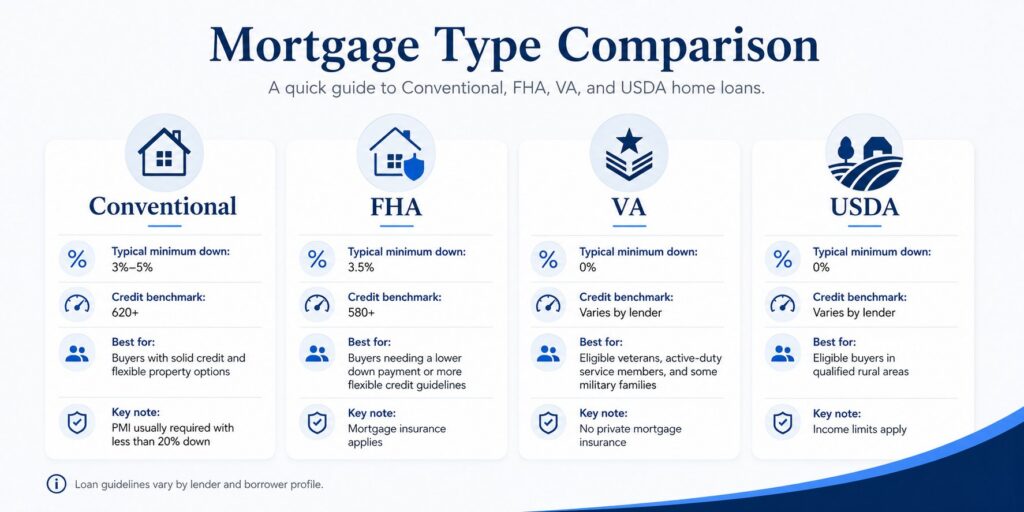
Conventional loan – offered through a bank, credit union, or private lender; typically 3–5% minimum down payment; a credit score of at least 620 is generally needed.
FHA loan – insured by a government agency (FHA); FHA loans require a minimum down payment of 3.5% for scores of 580+.
VA loan – for eligible veterans; often zero down payment and no private mortgage insurance.
USDA – zero down in eligible rural areas with income limits.
A 30-year fixed mortgage locks your interest rate for the full term, giving stable monthly payments. A 5/6 ARM might start lower but resets after five years, creating payment uncertainty. Each monthly mortgage payment includes principal, interest, property taxes, homeowners insurance, and possibly mortgage insurance. Mortgage insurance is needed if the down payment is less than 20%. Factor all of these in when estimating affordability.
Check Your Credit Report and Strengthen Your Credit Score
When you apply for a mortgage, the lender will pull your full credit report from Experian, Equifax, and TransUnion. You should check your credit first. In 2026, consumers can still get free reports at AnnualCreditReport.com, and reviewing all three bureaus helps spot inaccuracies before they cost you money.
Common errors include wrong balances, closed accounts showing as open, and late payments that aren’t yours. Even one mistake can raise the interest rate you’re offered or increase your required down payment.
To dispute errors, gather supporting documentation (bank statements, receipts), submit a dispute to each bureau reporting the issue, and contact the creditor that furnished the data. Investigations typically take around 30 days.
Credit score tiers matter significantly. Lenders typically prefer a credit score of at least 620 for a conventional loan, but borrowers in the mid-700s can qualify for rates 0.5–1.5% lower than those in the mid-600s. Improving your credit score can lead to better mortgage rates and save thousands over the life of a loan.
Practical steps to raise your score in 3–12 months:
Pay down credit card balances to keep utilization under 30%, ideally under 10%.
Make every payment on time, including small bills.
Avoid opening new high-limit accounts or co-signing for others.
Avoid credit problems like large unexplained financial changes before applying.
Know How Much House You Can Afford
The maximum a lender approves is almost always more than what’s actually comfortable. Smart home buyers set their own ceiling based on real household spending, not just a lender’s formula.
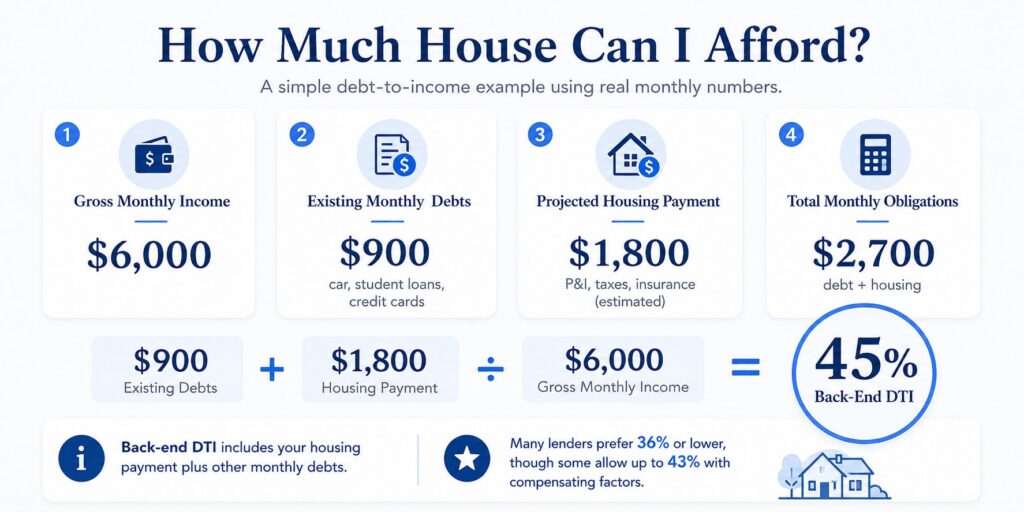
The debt to income ratio is the key metric. Front-end DTI covers housing costs only; back-end DTI includes all monthly debt obligations. Many lenders prefer a DTI of 36% or lower, though some allow up to 43% with compensating factors.
Here’s a simple example: suppose your gross monthly income is $6,000 and your current monthly debt payments total $900 (car, student loan, credit cards). That’s a 15% DTI without a mortgage. Add a projected mortgage payment of $1,800, and your back-end DTI jumps to 45%, which may push beyond what most lenders find comfortable.
Use an online affordability calculator, then review our Denver buyer payment strategy guide as you build a full household budget that accounts for utilities, childcare, transportation, groceries, and savings. Rising property taxes and home insurance costs across many markets in 2025–2026 can push your payment higher over time, so leave a 5–10% buffer.
Don’t drain your emergency savings for a bigger house. Keeping at least 3–6 months of expenses in cash reserves protects your financial situation against income shocks, surprise repairs, and the costs of home ownership that appear in year one.
Plan Your Down Payment and Upfront Costs
Your down payment size directly affects your loan amount, monthly payments, and whether you pay private mortgage insurance. A common down payment guideline is 20% of the home’s price. A 20% down payment can help avoid PMI, while the median first-time homebuyer down payment is closer to 10%.
Consider a $400,000 home purchase. At 20% down ($80,000), you borrow $320,000 with no PMI. At 5% down ($20,000), you borrow $380,000 and pay PMI until you reach 20% equity. At a 6.5% interest rate, the difference in total interest paid over 30 years is substantial. A larger down payment reduces lender risk and can improve loan terms across the board.
Common down payment sources include personal savings, liquidated investments, 401(k) loans or withdrawals (watch for taxes and penalties), and gifts from family documented with a gift letter. Many states also offer down payment assistance programs, some providing forgivable loans of $10,000–$15,000 for eligible buyers.
Don’t spend every dollar on the down payment. Moving costs, minor repairs, and furnishings in the first year require more money than most people expect.
Closing costs typically run 2–5% of the loan amount. On a $400,000 home, that’s $8,000 to $20,000 covering lender fees, appraisal ($300–$800), title search, recording fees, and prepaid taxes and insurance. Seller credits or lender credits can offset these costs, though a lender credit usually means accepting a slightly higher interest rate. Decide whether the trade-off fits your financial means and timeline.
Compare Loans, Lenders, and Mortgage Brokers
Shopping for a mortgage in 2026 can easily save thousands over the life of a home loan. Comparing multiple lenders can save borrowers thousands, and research shows that getting one additional rate quote can save $1,500 on average.
You can go directly to a bank or credit union, or work with a mortgage broker who shops multiple lenders’ pricing, guidelines, and loan terms on your behalf. A loan officer at a single institution offers only that institution’s products, while a broker accesses wholesale lenders you might not find on your own.
A local mortgage broker brings real advantages: better knowledge of neighborhood appraisals, state-specific assistance programs, and local underwriting quirks. Use Google reviews and recent online ratings to evaluate brokers and lenders. Focus on comments about communication, closing on time, and resolving issues, not just star counts.
Get at least three written loan estimate documents on the same day when possible. Comparing loans on the same day ensures accurate estimates so you can fairly compare the interest rate, APR, lender fees, and mortgage insurance. Shop for a loan within a 45-day period to minimize credit impact, since scoring models treat multiple mortgage inquiries in that window as a single hard inquiry.
Always ask a broker directly about compensation: how they’re paid, whether there are lender credits or points, and whether any prepayment penalties are hidden in the fine print. Compare all loan terms, not just the mortgage rate, to find the best deal.
Get Pre-Approved Before You House Hunt
Pre-qualification is informal, based on self-reported income and debts. Pre-approval is documented: the lender pulls your credit, verifies income and assets, and issues a conditional commitment. The mortgage application process generally involves structured steps, and key milestones include pre-approval, loan processing, and closing.
Documents you’ll need to apply for a mortgage and obtain pre-approval:
Last 30 days of pay stubs
Last 2 years of W-2s or tax returns (self employed borrowers should include business returns and profit/loss statements)
2–3 months of bank statements and financial accounts
Government-issued ID
Statements for all debts (student loans, car loans, credit cards)
Lenders typically look for at least two years of stable employment. A strong pre-approval letter, dated recently with a clear maximum loan amount, helps you compete in tight markets. Preapproval helps show sellers that you are a serious buyer who can perform.
Shopping for a mortgage within 45 days minimizes credit score impact because multiple inquiries are treated as one for scoring purposes. Some local brokers and lenders even offer fully underwritten pre-approvals, which make your offer nearly as strong as cash because income and assets are already verified.
Start 60–90 days before you plan to make offers. That gives you time to fix credit issues, gather documents, and get into the best programs without rate lock pressure. If you are deciding where to apply, learn more about the differences between a mortgage broker and a bank.
Understand Loan Terms, Interest Rates, and Fine Print
The interest rate on your mortgage agreement is only one piece of the puzzle. You must read all loan terms before you sign. The Annual Percentage Rate (APR) includes many fees and gives a better picture of the loan’s total cost than the rate alone.
Loan term length also matters. A 15-year fixed on a $300,000 loan at 6.0% has higher monthly payments than a 30-year at 6.5%, but you’ll pay dramatically less total interest and own your home sooner. Buying discount points can reduce the interest rate in exchange for higher upfront fees, which may make sense if you plan to stay long-term.
Rates can change daily and should be locked in before closing. A rate lock guarantees your quoted rate for a set period (30, 45, or 60 days). In volatile 2026 conditions, locking protects you if rates rise before your closing date.
For adjustable-rate mortgages, understand the initial fixed period, the index, margin, caps, and how your payment could jump after the reset. Avoid features like prepayment penalties, balloon payments, or negative amortization unless you fully understand the risk and have a clear exit plan.
Federal law requires lenders to provide a standardized loan estimate within three business days of your loan application, and a closing disclosure at least three days before closing. Lenders must provide a loan estimate after application submission. Compare both documents carefully for last-minute changes.
Avoid Common Mortgage Mistakes Before Closing
From the moment you apply for a mortgage until closing day, your finances are under a microscope. The lender needs to verify financial information during the loan processing stage, and any major change can derail your approval.
Common pitfalls to avoid:
Avoid opening new credit accounts during the mortgage application process.
Don’t finance a car, take on new debt, or add a co borrower without discussing it with your lender.
Large unexplained deposits into your financial accounts will trigger questions.
Changing jobs mid-process can reset employment verification.
Keep all financial paperwork organized and respond quickly to underwriter requests. Responding quickly to requests for documents can help keep the mortgage process on schedule and prevent your rate lock from expiring.
A home appraisal is required by the lender to confirm the property is worth the loan amount. A home inspection is separate and evaluates the condition of the roof, plumbing, electrical, and structure. Even when not required, an inspection protects the buyer and can be a powerful negotiating tool.
At closing, expect to review the closing disclosure at least three business days in advance. Bring a certified or cashier’s check or wire funds carefully, verifying wire instructions to avoid fraud. If the numbers on the final documents don’t match expectations, pause and get clear answers before you sign. Even under time pressure, careful consideration of every line protects your money and your home purchase.
For personalized guidance on comparing lenders and choosing a loan, learn more about Ryan Davis.
FAQ: Practical Questions About Getting a Mortgage
How long does it take to get a mortgage from application to closing in 2026?
Most straightforward mortgage applications close in 30 to 45 days. Complex cases involving appraisal delays, title issues, or income verification for self employed borrowers can stretch to 60 days or longer. Staying organized and responsive with documentation helps you stay on the shorter end.
Is it better to pay off debt or save for a down payment first?
It depends on your financial situation. High-interest debt like credit cards often costs more over time, and paying it down improves your debt to income ratio, which can help you qualify for a lower rate. But draining savings completely to eliminate debt leaves you without reserves. Balance both: reduce high-cost debt while maintaining enough savings to cover your down payment and several months of expenses.
Should I work with a local mortgage broker or an online lender?
A local mortgage broker offers personal service, knowledge of area appraisals and state assistance programs, and relationships with underwriters that can speed up processing. Online lenders may offer streamlined apps and competitive digital pricing. Check Google reviews for either option, focusing on recent feedback about communication, timeliness, and closing outcomes. Many home buyers find that a local broker who can shop pricing from several lenders delivers the best overall experience.
What if my credit score is borderline, around the mid-600s?
If your score temporarily lowers your buying power, delaying 6–12 months to improve it can reduce your rate by 0.5–1.0% or more, potentially saving thousands over the loan’s life. Pay down revolving balances, correct reporting errors, and avoid new debt. However, if mortgage rates are expected to rise, waiting could cost more in interest than you save from a higher score. Weigh your own credit improvement trajectory against rate forecasts before you decide.
Do I really need to compare more than one or two lenders?
Yes. Research consistently shows that getting one additional rate quote saves $1,500 on average. Request a loan estimate from at least three sources, including a local mortgage broker, a credit union, and a direct lender. Comparing on the same day keeps rate conditions consistent, giving you the clearest picture of which lender offers lower monthly payments and the most favorable overall terms.
Looking to secure a VA mortgage Colorado Springs? This guide will help you understand your options, benefits, and how to qualify. We cover everything you need to know to get started today.
Key Takeaways
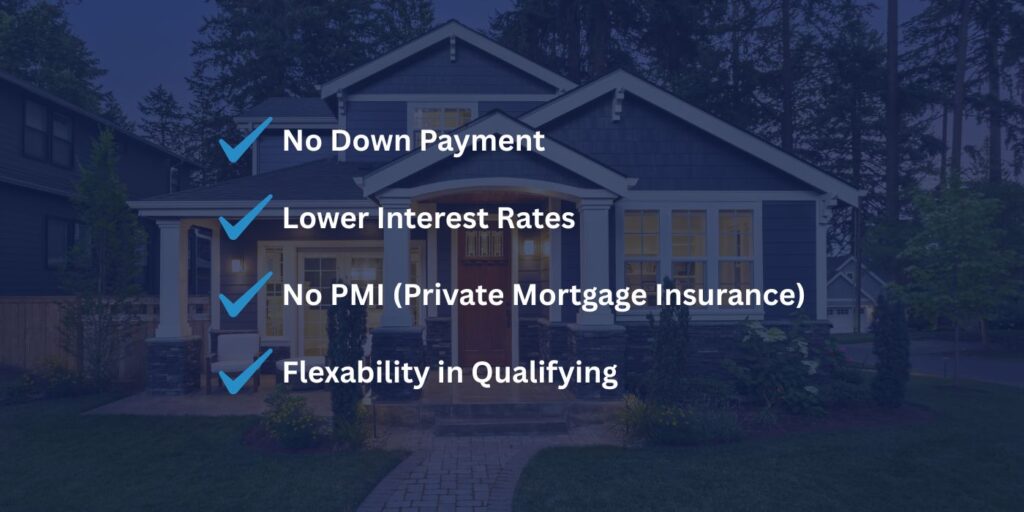
VA loans in Colorado Springs offer significant benefits, including no down payment, lower interest rates, and no private mortgage insurance (PMI), making homeownership more attainable for veterans and servicemembers.
Eligibility for VA loans primarily depends on military service, with flexibility in credit score requirements allowing more veterans to qualify, even with less-than-perfect credit histories.
Understanding the loan limits, application process, and potential closing costs associated with VA mortgages is essential for veterans to navigate their home-buying experience effectively.
Understanding VA Mortgages in Colorado Springs
VA loans are government-backed mortgages provided by approved lenders to assist veterans and servicemembers in becoming homeowners. In Colorado, these loans are guaranteed by the Veterans Affairs (VA), reducing the risk for lenders and enabling them to offer loans to qualified borrowers. This guarantee means that if a borrower defaults, the VA will cover a portion of the existing va loan, making VA loans a safer bet for lenders.
One of the standout features of VA loans is the absence of private mortgage insurance (PMI). Unlike conventional loans, which often require PMI if the borrower puts down less than 20%, VA home loans eliminate this additional cost, making monthly mortgage payments more affordable. Additionally, VA loans typically offer more favorable terms, such as no prepayment penalties and lower interest rates, further easing the financial burden on veterans and servicemembers.
The VA home loan program is designed to offer a path to homeownership with fewer barriers and more support. From the application process to loan closing, VA loan specialists can provide guidance tailored to the unique needs of military families. Grasping these basics prepares you to explore the numerous benefits and options available through VA loans in Colorado Springs.
Benefits of VA Mortgages in Colorado Springs
VA mortgages come with a host of benefits that make them an attractive option for veterans and servicemembers in Colorado Springs.
One of the most significant advantages is the ability to finance the entire home price without needing a down payment. This feature alone can be a game-changer, removing a significant barrier to homeownership. — Ryan Davis
VA loans typically offer lower interest rates compared to conventional loans. Lower interest rates can translate into substantial savings over the life of the loan, making it more affordable in the long run. Moreover, Eliminating private mortgage insurance (PMI) significantly reduces monthly payments. This can free up more of your budget for other essentials or savings.
VA loans are also more accessible to borrowers with diverse credit histories. Unlike conventional loans that often have stringent credit requirements, VA loans work and are more forgiving, making homeownership possible for those with less-than-perfect credit. Additionally, VA guarantees help to further secure these loans for eligible borrowers.
These VA home loan benefits collectively make VA mortgages a powerful tool for veterans and servicemembers aiming to secure their financial future and access va benefits.
Eligibility Requirements for VA Mortgages
Eligibility for VA loans is primarily based on military service. Generally, active-duty military members, veterans, Selected Reserve members, and certain spouses can qualify. Military service members must have served at least 90 consecutive days of active wartime service or 181 days of peacetime active service to qualify. This ensures that the benefits are reserved for those who have dedicated a significant portion of their lives to serving the country.
Most lenders typically require a minimum credit score of around 620 for VA loans. While the VA does not set a standard minimum credit score, lenders may impose their own requirements based on the borrower’s low credit score and credit scores profile. This flexibility allows more veterans to qualify for a VA loan, even if their credit history is less than perfect.
Surviving spouses of veterans and military spouses are also eligible surviving spouses to apply for a VA loan under the same guidelines. Additionally, there are provisions for exemptions from certain fees, particularly for those receiving service-connected disability compensation. Knowing these eligibility requirements helps veterans and their families fully benefit from the VA home loan program.
Types of VA Mortgage Programs Available
VA loans come in various forms to suit different needs. One common option is the Fixed Rate Mortgage loan, which offers predictable monthly payments and a stable interest rate over the life of the loan term. This can be particularly beneficial for borrowers who plan to stay in their homes for a long period.
For those who prefer flexibility, Adjustable Rate Mortgages (ARMs) are available. ARMs typically start with a lower interest rate that adjusts periodically based on market conditions. This can be advantageous if you expect your financial situation to improve or plan to sell the home before the rate adjusts.
The VA Cash-Out Refinance Loan allows homeowners to access cash from their home’s equity while refinancing their existing loan. To be eligible for this program, homeowners must have made at least six months of payments on their existing mortgage. This option is ideal for those looking for debt consolidation or finance home improvements.
Another popular program is the Interest Rate Reduction Refinance Loan (IRRRL), which helps VA mortgage holders reduce their interest rates and monthly payments and loan payment with minimal documentation. Additionally, refinance loans like the Native American Direct Loan (NADL) program offer favorable terms for eligible Native American veterans, providing more options for financing their homes.
Familiarizing yourself with these VA mortgage programs can help you select the one that best fits your needs.
VA Mortgage Rates in Colorado Springs
The average national rate for a 30-year VA loan is 6.2% to 6.5%, with brokers often able to access even lower rates. VA mortgage rates are often lower than those of other mortgage types, but they can vary based on several factors. The U.S. Department of Veterans Affairs does not set these rates; lenders determine the mortgage rate.
Market factors such as inflation and employment growth can significantly impact VA mortgage rates. Additionally, lender-specific factors, including profit margins, play a crucial role in determining the rates offered to borrowers. Therefore, it’s essential for borrowers to shop around and compare rates from different lenders to find the most competitive interest rate.
The Annual Percentage Rate (APR) is another critical factor to consider. Even if a lender offers a low interest rate, high lender fees can lead to a higher overall cost if the APR is high. VA loan rates may also differ from refinance rates, with refinance rates typically being about one percentage point higher. Being aware of these nuances can help you make an informed decision when securing a VA mortgage.
VA Mortgage Limits in Colorado Springs
In 2026, the standard VA loan limit for Colorado Springs (El Paso County) is $832,750 for a one-unit property, including most single-family homes. Loan limits can vary by county based on local home values. In Colorado’s higher-cost counties, the one-unit limit can go as high as $1,249,125. Keep in mind that VA loan limits generally only apply if a borrower has partial entitlement; borrowers with full VA entitlement don’t have a loan limit, as long as the lender approves the loan and the appraisal supports the price.
VA loan limits can vary slightly based on local housing market conditions, so it’s essential to check the specific limits for your area. Veterans fully utilizing their entitlement can borrow without any limit on down payment requirements, making it easier to afford homes even in higher-priced markets. However, if a borrower has remaining entitlement, they may need to make a down payment to cover any excess over the limit.
Knowing these loan limits and their application to your situation can aid in planning your home purchase more effectively. Consulting with a VA loan specialist can provide detailed information on specific limits in your area.
The VA Mortgage Application Process
The first step in applying for a VA loan is to obtain a Certificate of Eligibility (COE). This document verifies that you meet the eligibility requirements for a VA loan. You can apply for a COE online, through your lender, or by mail. Once you have your COE, the next step in the va loan process is to receive a personalized quote for your VA loan online.
After obtaining a quote, you will need to submit your loan application along with the necessary documentation, such as proof of income and credit history. Upon submission, you will be required to sign various disclosures. This step ensures that you understand the terms and conditions of the loan.
The final step in the application process involves reviewing and notarizing the loan documentation before closing. This is when you will also pay any applicable closing costs and fees. Completing the VA loan application process can seem complex, but with the assistance of a knowledgeable loan officer, it can be a smooth and straightforward experience.
VA Mortgage Appraisal and Inspection Requirements
In Colorado Springs, properties financed with a VA loan must be a primary residence and meet specific structural safety standards. The VA Minimum Property Requirements (MPRs) ensure that homes are safe, structurally sound, and sanitary for occupants. These standards include:
Having working utilities
Access to safe drinking water
Proper sewage disposal
Year-round access by reliable roads
VA appraisers conduct appraisals to assess both the property value and compliance with MPRs. They report any defects or presence of wood-destroying insects that might compromise the property’s safety. A Notice of Value (NOV) is issued after the appraisal, which is valid for six months and can guide further negotiations or repairs.
While the VA does not mandate home inspections, they are highly recommended for a thorough evaluation of the property. Failure to meet the MPRs can result in the denial of the loan unless the seller agrees to make the necessary repairs. Knowing these appraisal and inspection requirements can help you avoid potential pitfalls during the home buying process.
VA Mortgage Closing Costs and Fees
Closing costs for VA loans can vary significantly based on factors like the loan amount and property location. One of the primary costs is the VA funding fee, which can include funding fees that:
Ranges from 0.5% to 3.3% of the loan amount
Can be reduced or waived for veterans with service-related disabilities
Can be included in the total loan amount, allowing borrowers to pay it over time.
Sellers are permitted to cover up to 4% of the home’s reasonable value in closing costs, which can significantly reduce the out-of-pocket expenses for the buyer. Common components of closing costs include:
Loan origination fees
Appraisal fees
Title insurance While the VA funding fee is fixed, lender fees can vary and are negotiable, impacting your overall loan cost.
Managing these costs effectively can make a significant difference in your home buying experience. Understanding the various fees and exploring ways to minimize them can ensure a smoother and more affordable loan closing process.
Tips for Choosing a VA Mortgage Lender in Colorado Springs
Choosing the right VA mortgage lender is crucial to securing favorable terms and a smooth loan process. Selecting a lender with extensive VA loan experience is crucial. An experienced lender can navigate the complexities of the VA loan program and offer tailored advice to meet your specific needs, making them va loan experts.
Some lenders operate entirely online, which can be a convenient option for active-duty military personnel stationed away from home. Additionally, considering the benefits of using an independent mortgage broker versus a bank or online-only lender can help you find the best rates and terms for your situation.
Carefully selecting your lender maximizes the benefits of your VA home loan program and ensures a successful home buying experience.
Ryan Davis: VA Home Loan Experience You Can Trust
Buying with a VA loan should feel clear, not confusing. Ryan Davis helps veterans and military families move forward with confidence through honest advice, responsive communication, and experienced guidance from start to finish. Ryan Davis brings more than 20 years of lending experience, and as a NAMB Certified professional, he offers recognized industry expertise backed by a commitment to serving buyers with clarity, integrity, and confidence. Client reviews consistently highlight the team’s professionalism, speed, and ability to keep deals moving in competitive situations. If you want a mortgage partner who will explain your options clearly and help you navigate the process with less stress, Ryan Davis is a strong choice for VA home loans in Colorado Springs.
In summary, VA mortgages offer a range of benefits that make homeownership more accessible and affordable for veterans and servicemembers in Colorado Springs. From no down payment requirements and lower interest rates to the elimination of private mortgage insurance, VA loans are designed to support those who have served our country.
By understanding the various aspects of VA mortgages, including eligibility requirements, types of loan programs, and the application process, you can make informed decisions that align with your financial goals. Whether you’re purchasing your first home or refinancing an existing VA loan, the VA home loan program provides valuable resources to help you achieve your dream of homeownership.
Frequently Asked Questions
What is the primary benefit of a VA loan compared to a conventional loan?
The primary benefit of a VA loan is that it allows you to finance the entire home price without needing a down payment, unlike conventional loans. This can make homeownership more accessible for eligible veterans and service members.
Who is eligible for a VA loan?
To be eligible for a VA loan, you must be an active-duty military member, veteran, Selected Reserve member, or certain qualifying spouses, with a minimum service time of 90 consecutive days during wartime or 181 days during peacetime.
What is the VA funding fee?
The VA funding fee, which ranges from 0.5% to 3.3% of the loan amount, can be waived or reduced for veterans with service-related disabilities and may be financed as part of the total loan.
What are VA Minimum Property Requirements (MPRs)?
VA Minimum Property Requirements (MPRs) ensure that homes are safe, structurally sound, and sanitary for occupants. They include standards for working utilities, safe drinking water access, proper sewage disposal, and reliable year-round road access.
Can surviving spouses of veterans apply for a VA loan?
Yes, surviving spouses of veterans can apply for a VA loan under the same guidelines as veterans. This allows them access to valuable benefits and support in achieving home ownership.
We use cookies and similar technologies to improve your experience on our website.
Read our Privacy Policy.